Thursday, September 04, 2008

Stuff to See Tonight

The first Thursday after Labor Day marks the beginning of the fall art season. Why do we all still live by the semester cycle? Anyway, some good stuff is happening tonight in the Bay Area. Here's where I'll be:


Bayete Ross Smith

Bayete Ross-Smith and Jonathan Burstein
Patricia Sweetow Gallery
77 Geary Street, Mezzanine, San Francisco
5:30-7:30 pm


David Maisel

David Maisel: Library of Dust
Cheryl Haines Gallery
49 Geary Street, 5th floor, San Francisco
5:30-7:30 pm


Jillian McDonald

Jillian McDonald: Movie Stars and Monsters
Headlands Center for the Arts
944 Fort Barry, Sausalito
7:30-9 pm

Wednesday, September 03, 2008

The Wizard of Oz at CCA Wattis Institute for Contemporary Art

Last night was the opening of The Wizard of Oz at my alma mater, California College of the Arts. Like always at the start of the semester, it was a full house, and the subject matter was well-suited to Wattis Director Jens Hoffmann's theatrical approach. The path of exhibition, which juxtaposed works by several notable international artists with ephemera from the titular novel and 1939 film, followed a narrative arc loosely based on that of the source material.


Walker Evans, Part of the Bedroom of an Alabama Cotton Sharecropper,
Hale County, Alabama
, 1935


The show opens with multiple beginnings. The American Midwest, where the story begins, is represented here by Walker Evans' powerful photographs of threadbare farm houses, which date to roughly the same time as the MGM film starring the teenaged Judy Garland. A large wall installation by Donald Urquhart chronicles thehistory and the dark side of the film's creation in a style derived from cheery children's book illustrations. Between these is a first edition of L. Frank Baum's novel, accompanied by reprints of early reviews, representing the start of a long cultural engagement with the book.


Clare Rojas, Woman in Yellow Dress in Poppy Field, 2008

Works such as Clare Rojas' drawings of women playing in a field of poppies, Evan Holloway's ax poised to chop, or Felix Gonzalez-Torres' images of birds flying through cloudy skies, can be read literally within the context of the story. Other works such as Bruce Conner's film Valse Triste have more subtle connections to the theme. Rivane Neuenschwander's installation Eu desejo o su desejo (I wish your wish) casts gallery visitors as Dorothy and her entourage, wishing for respite from the difficult journey ahead. Film originals include a first-run print, a Gramophone playing a recording of "Somewhere Over the Rainbow" and a pair of genuine Ruby Slippers.


The culminating work in the show is Steve McQueen's Once Upon a Time, in which images collected by NASA as indicators of human society and sent into space for alien consumption have been strung together and accompanied by a soundtrack of people speaking in tongues. The effect is wonderfully evocative of the Great and Terrible Oz - both ridiculous and full of hubris. Though traces of those characteristics can be found throughout the show, the negatives are outweighed by the strong use of space to describe a narrative, the visual interest of art mixed with cultural artifacts, and the iconoclastic takes of several artists on the literary source material.

The show runs through December 13.

Wednesday, August 27, 2008

Women's Equality Day at the Democratic National Convention

Yesterday, August 26, was Women's Equality Day, commemorating the 88th anniversary of the passage of the 19th Amendment which granted women the right to vote in the United States. At the Democratic National Convention, women were all over a program which included near-miss presidential candidate Hillary Rodham Clinton, Kansas governor Kathleen Sebelius, Arizona governor Janet Napolitano (whom I can't help but confuse with Concrete Blonde singer Johnette Napolitano), and equal pay activist Lilly Ledbetter. Despite the preponderance of powerful, successful women and their heartfelt speechifying, there was plenty of evidence that equal rights for women aren't yet a reality.


Lilly Ledbetter at DNC

Ledbetter's case is particularly discouraging. Over 20 years of solid, hard work at Goodyear Tire, she was consistently paid less than male peers for the same work. Upon discovering the discrepancy, she filed a suit which she won at the District Court level, but lost on Supreme Court appeal. The Supreme Court decision that equal pay lawsuits must be filed within 6 months of the offense, not the discovery of the offense, essentially protects all employers from liability for discriminatory practices. Employees are prohibited from knowing what their peers are paid, so how can they know about discrepancies in time to file a lawsuit? This case was one of the very worst examples of how the Bush presidency has destroyed the Judicial branch. A House bill to rectify this egregious pandering to corporate interests was killed in the Senate. Congratulations ladies (and men - anyone can suffer discrimination), you officially have no recourse.


Kathleen Sebelius at DNC

Another disgusting example of entrenched sexism was provided by the commentary surrounding Sebelius' speech. A few weeks back, Kathleen Sebelius was the subject of much speculation as a possible Vice Presidential candidate on the Obama ticket. On broadcasts today, it was accepted as given that she could not have been selected because the choice of another woman would offend Hillary Clinton and her supporters. This is probably true, and if so it is genuinely appalling and reactionary behavior by so-called feminists. To promote the stereotype that women won't support other women in the professional realm, and that there can only be one token woman in a leadership position in any organization, is entirely counterproductive. Between this and the P.U.M.A. morons, die-hard Clinton supporters are poised to set women's rights back by decades. News flash - equal rights sometimes means an equal right to come in second, not preferential treatment when it suits you and equality the rest of the time. These self-righteous and spiteful characters definitely fall into the "won't you just die already?" category.


Hillary Rodham Clinton at the DNC

Finally, it bears noting that Bill Clinton - with his peevish, over-macho posturing with respect to Barack Obama - continues not to do his wife any favors politically. She spent decades grooming and nurturing him into the highest office in the land, stood by him when his megalomaniacal sexual deviancy got him in heaps of trouble, and this is how she is repaid. Why she and her class act of a daughter haven't kicked him to the curb is beyond me.

At least one ongoing thorn in my side seems to have resolved. It never ceased to bug me throughout the primaries when commentators would refer to Candidate Clinton as "Hillary" while referring to Candidate Obama as "Obama." It's not as though we were going to suddenly confuse her with Bill - and using her first name was a means for her opponents to undermine her seriousness as a viable candidate. She fell prey to that one herself, emphasizing "Hillary" in a strange attempt to disassociate herself from her churlish husband. It didn't help her cause.

Anyway, it appears that Obama supporters have belatedly leveled that playing field, as throughout the day I heard him referred to quite casually as "Barack." Oh, for a glimmer of post-gendered hope!

Wednesday, August 20, 2008

Part 2 - Art Since the 1960s: California Experiments

Documentation from Chris Burden's 1972 TV Hijack is presented adjacent to Wegman in the Video gallery. The politics and ethics of this piece have always fascinated me, as they point out thorny issues within contemporary art and media practice.

Burden was invited to be a guest on a public-access interview show hosted by Phyllis Lutjeans, one-time Curator of Education and Performance Art at Newport Harbor Art Museum (aka OCMA). He arrived with his own videographer, and requested that the interview be broadcast live, which it was. During the course of the interview, Lutjeans asked him what some of his ideas for future projects might be. Burden responded by pulling out a small knife and holding it to her throat. He demanded that the station continue transmitting while he held his host hostage, abusing her verbally with sexual threats. The performance culminated with Burden's destroying the only studio tape of the broadcast, an act which he recorded as the coda to his own document of the event.


Chris Burden, TV Hijack, 1972 (click for attribution)

Burden had employed violence in his works before, most famously with Shoot, 1971, in which he had an assistant shoot him in the arm with a .22 rifle inside a Santa Ana gallery. The earlier action was billed as a performance, the spectators and participants relatively clear as to their roles in what would take place. The difference with TV Hijack was that Lutjeans was not a willing participant, and at the time, she genuinely believed that her life was at risk. Burden's use of another person's genuine terror as the means for his art, coupled with the nasty introduction of gender-specific power dynamics through his use of obscene threats, make this his most vicious and hostile project - more so even than Trans-fixed, 1974, in which he was nailed to a Volkswagen Beetle by the hands and feet.


Chris Burden, Trans-fixed, 1974 (click for attribution)

TV Hijack is generally less well-known than Shoot or Trans-fixed. Perhaps this is because documentation of the piece is more difficult to come by, but I think it also has to do with an unwillingness among the contemporary art illuminati to call a sexist, violent action what it is, and the fact that many art historians and critics would prefer to gloss over this ugly reality in favor of a detached, over-critiqued analysis of Burden's oeuvre that treats fear and abuse as an inside joke.

The question posed by any act of mimicry as critique is, does the action cross over into becoming what it is intended to criticize? In the case of TV Hijack, it does. The criticism of media as a site of detachment from the consequences of violent action, as played out in countless summer blockbusters, war movies and the like, is negated by the artist's willful act of violence. This callousness toward human dignity has other manifestations in contemporary art practice, most notably in the work of Santiago Sierra, the Spanish artist whose works have included hiring migrant workers to stand for hours in a gallery and paying destitute individuals to tattoo a line across their backs.


Santiago Sierra, 250 cm Line Tattooed on 6 Paid People, 1999

Sierra argues, as does Burden, that these actions draw our attention to the violence we take for granted every day, fueled by divisions of class, race and gender. I disagree with the inherent assumption that we all take such violence for granted, regardless of where we stand in life, and argue instead that this is work directed at an affluent art world elite and justified by the same insularity it proposes to attack. I also question the validity of the artists' argument that because they mean to call attention, their exploitative acts are somehow less exploitative. Instead, it seems that the artists benefit and even profit from said exploitation, while those they take advantage of are left exactly as they were found. How is this different from the exploitation conducted by corporate interests for their own gain?

In summation, the art world is just another market economy fueled by the unremunerated contributions of nameless masses, while a very few (mostly white, mostly male) get the benefits. Artists like Burden and Sierra are important because they remind us of this reality in which they each play a complicit part.

Tuesday, August 19, 2008

Art Since the 1960s: California Experiments at Orange County Museum of Art

The Orange County Museum of Art has a thoughtfully didactic exhibition on view through September 14. Art Since the 1960s: California Experiments is divided into subject areas such as Conceptual Art, Performance, Pop Art, Assemblage and Installation. Each section features prominent California artists as well as documentation of national-profile art actions that took place in Southern California. The work is drawn from OCMA's collection, much of which was acquired through purchases from the old Newport Harbor Biennial under the museum's original moniker, Newport Harbor Museum of Art. It's enlightening to see Orange County positioned at the center of key movements in late 20th century American art, having served as a launching pad for the likes of Chris Burden, Eleanor Antin, Robert Irwin, William Wegman and James Turrell. Some of what's on view is familiar, some surprising.


William Wegman, Selected Works, William Wegman, 1973-74

William Wegman is one of the surprises here. Long known for portraits of his Weimaraners that often cross the line from ironic to kitschy, his early video works demonstrate that at one time he was fully engaged in a critique of 1970s video/performance art. He intelligently skewers Vito Acconci, Paul McCarthy, Bruce Nauman et al through funny videos that work seamlessly as conceptual art. Naturally, the dogs make an appearance. In one film, he impersonates a canine in a parody of Acconci's hyper-aggressive 1971 performance Claim, growling and snarling in the dark. In the next, he lectures his dog Man Ray about spelling errors, as if attempting to trade social roles with the animal.

Tomorrow: Some thoughts on Chris Burden's TV Hijack.

Monday, August 18, 2008

Help The Prids

Our good friends The Prids were in a terrible accident last month that cut short their west coast tour. This happened when I was in New York, so I only recently heard the details. The Portland, OR-based band were driving from a gig in San Francisco to one in Los Angeles when their cargo van blew a tire, causing the vehicle to fishtail and ultimately to roll over several times. Everyone is alive, thank (insert deity here), but like most independent artists, very few of the band members have health insurance. You can help by donating to their PayPal account here.


The Prids retrieve their gear from their smashed van, Firebaugh, CA, July 23, 2008

The Prids are known for their ethereal sound, which invokes early postpunk/New Wave. Unlike their contemporaries Interpol or The Faint, The Prids haven't yet developed a national profile, but they are every bit as deserving and this is soon to change. Touring is how they make their living, driving from town to town selling self-published CDs and hand-silkscreened merchandise. The Prids are lifers, in this business for real and not just to be cool or be famous (although they are the former and should be the latter).


The Prids performing in San Francisco

On top of their enormous talent and dedication, The Prids are also incredibly sweet, intelligent and all around nice people. As happens too often in this life, a terrible thing has happened to the people who least deserve or can afford it. Please help them get back on their feet so they can get back on the road to uncompromising musical success.

Wednesday, August 06, 2008

Arctic Hysteria: New Art from Finland at P.S. 1

Also at P.S.1 through September 15 is Artic Hysteria: New Art from Finland, which introduces sixteen contemporary Finnish artists to an American audience. Art from Finland, it turns out, is dark, honest, dryly humorous, and executed with sophistication. All media from drawing to sculpture to video to installation are included, along with some creative uses of P.S. 1's more unconventional spaces.


Pekka Jylhä, I Would Like to Understand, 2000-01

A spooky rabbit by Pekka Jylhä lurks in a corner inside the galleries. Another sits at the edge of a massive saucer, pondering or perhaps commanding it. Though tiny, they are menacing, and their intentions are never clear. Jylhä has used stuffed rabbits, goats and birds in several works. Each seems burdened with terrible knowledge.


Tellervo Kalleinen & Oliver Kochta-Kalleinen, Complaints Choirs, 2005-08

Complaints Choirs, organized by Tellervo Kalleinen and Oliver Kochta Kalleinen, invites people in cities around the world to come together and sing about how much the world sucks. Participants in Birmingham, Helsinki, St. Petersburg, Hamburg, Chicago and Singapore have created their own lyrics, submitting their complaints ahead of time. Accepted without audition, their laments are robust nonetheless.


Stiina Saaristo, The Celebration-Festen, 2006

Stiina Saaristo's large graphite on paper drawings depict festively clad, glum-faced figures in ostentatious surroundings. Clad in gowns, these stern characters are matronly yet ambiguously gendered. The drawings are hyper-realistic and detailed, the silk of the dresses soft and luxurious. In its grotesque decadence, Saaristo's work evokes Velazquez, referencing the doll-like princess of Meninas in one image.


Veli Grano, installation view at P.S. 1


P.S. 1's converted city school building provides some wonderfully strange gallery spaces. Veli Grano's film installations are situated in the basement boiler room, beside the 100+ year old wood-fired central heating oven. The history of the building is complex, spanning a political machine-driven scandal over its construction, the consolidation of the City of New York from independent municipalities, 70 years of elementary school students and 32 years as a contemporary art mecca. The boiler room is cavernous, filled with dusty pipes and canisters, and Grano's atmospheric black-and-white films haunt the space.


Veli Grano, Meet You in Finland Angel, 2000-03

Grano's work is based in documentary methods. The centerpiece, Meet You in Finland Angel, introduces a tireless cart collector at a popular ferry terminal, and his house-bound wife. His seven-day-a-week schedule leaves her alone with her sorrow, which eventually reaches a peak. Smaller video portraits of these subjects peek out from within the room's vast heating machine.


The Futuro Lounge, an homage to Finnish architect Matti Suuronen's futuristic design of the Futuro House from 1968, 2008

A more utopian architecture also plays a part. One gallery is given over to the Futuro Lounge, a reimagining of architect Matti Suuronen's 1968 Futuro House. A pocket-house designed to function as a ski lodge, it has been adapted into a video lounge. Its tranquility is inviting, but the sleek white surfaces can be intimidating. The atmosphere is oppressive enough that it becomes apparent why the original houses were discontinued after 10 years. Still, the project is significant for its inventive approach to exhibition design.

Still many more artists are to be discovered in the exhibition, which spans 1 1/2 floors of the enormous building. Though the show ascribes a neurotic nature to the Finns, much of the show feels contemplative. The cold and dark seem to enable a certain emotional directness to emerge from the Finnish landscape, resulting in a clear-eyed look at the human condition.

More images of the exhibition can be seen here.

Monday, August 04, 2008

NYC Waterfalls by Olafur Eliasson

The New York City Waterfalls, on view along New York's East River through October 13, are four installations on the Manhattan, Brooklyn and Governor's Island waterfronts. They can be seen from any of several riverside parks or by boat. Circle Line is offering some free tickets to see the project, though they are hard to come by. I managed to take advantage of the free boat ride by getting up absurdly early in the morning, which resulted in the following video:

NYC Waterfalls: Brooklyn Bridge, 2008

The Waterfalls cost roughly $15.5 million to construct and install, mostly supported by private donations via the Public Art Fund but also by $2 million from the city's Lower Manhattan Development Corporation. Like most public art installations, they are controversial. The scale of the four installations is quite small in relation to the famous Manhattan skyline and the Brooklyn and Manhattan bridges. 90-120 feet tall, they seem insignificant not only against the architecture, but also the majestic East River waterfront. At the same time, they have been paid for in part by public money, which begs the question of whether supporting a famous European import like Eliasson is an appropriate use of lower Manhattan's development monies. Considering the fact that New York's artists are rapidly being priced out of Manhattan altogether, many people feel it is not.

NYC Waterfalls: Pier 35, Manhattan, 2008

In a way, the Waterfalls are similar to other Public Art Fund projects, in which monumentalism is generally eschewed in favor of subtle gestures like Lawrence Weiner's permanently installed manhole covers, or performances like this past spring's Rodney Graham Band featuring the amazing Rotary Psycho-Opticon. Their structures are exposed scaffolds just like those surrounding large-scale construction in the city. The mechanism of the Waterfalls is presented matter-of-fact, with no effort to hide either the filtration pools from which the water is drawn nor the pipes which carry it up the scaffolds.


How the Waterfall Works (click for link)

Personally, I appreciated the understated scale of the Waterfalls, though I understand how many might feel that they are unworthy of their budget or hype. My experience as a viewer focused on the river itself, the newly built parks along both shores and the rare treat of a boat trip which most New Yorkers never take. It's debatable whether the river requires Eliasson's help to be a summer destination - most NYC residents' lack of air conditioning seems to accomplish that - but as a gesture to highlight significant reclamation work done on the city's waterfront, this seems adequate.

It is necessary to ask, can a public art project - especially a costly one - get away with simple sufficiency? Is Eliasson's claim that the work is about exhaustion good enough? Or is this project another example of an artist building a worse mousetrap and calling it Conceptualism? With Eliasson, the answers to such questions are never clear, and the museum establishment's embrace of him only serves to further confuse the issue.

Reversed Waterfall, 1998, installation at P.S. 1

Other examples of Eliasson's work with water and undisguised mechanisms are on view at P.S. 1 through September 15. More video of the Waterfalls and related projects can be seen here.

Subscribe in a reader

Saturday, August 02, 2008

The Corpse Walker by Liao Yiwu

I recently read The Corpse Walker: Real Life Stories: China from the Bottom Up by Chinese dissident, activist and writer Liao Yiwu. This remarkable book was recommended to me by the great independent American journalist Phillip Robertson, who is about to embark on his fifth tour in Iraq as a reporter for the Associated Press. Phillip is one of the few journalists who has managed to report on the Iraq war since its inception with a minimum of pro-Bush administration agenda meddling, censorship or spin applied to his work. He is a dear friend and someone I trust completely for insights on both current events issues and literary recommendations.

The Corpse Walker is a collection of interviews with prisoners and social outcasts in China, all of whose stories reflect the tragic effects of Maoism in that country. Some are innocent bystanders caught up in events beyond their control, while others are vicious and petty criminals. Each one describes unthinkable atrocities, made more horrific by the matter-of-fact way in which they are recounted. The stories of starvation, persecution, corruption and abject, mindless cruelty are so horrific that they could not possibly be made up - only real life can be so truly terrible. Sexual slavery, cannibalism, wanton theft and property destruction have all been tacitly promoted by the rigid policies of the Chinese Communist party, strewing devastation throughout that country so that an entire generation of Chinese who lived through the failed social experiments of the Great Leap Forward and the Cultural Revolution consider their lives completely wasted.

With all the hype surrounding the 2008 Beijing Olympics, it is easy to forget that Chinese society remains closed, its government tyrannical and its people largely oppressed. The massacre at Tianenmen Square happened less than 20 years ago, and its consequences continue to be felt even as economic prosperity sweeps through much of urban China. Read The Corpse Walker before you watch the opening ceremonies and remember how the international community has conspired to squash all protest of Chinese policies on Tibet, Falun Gong and dissent among its citizenry.

They'll probably never let me back into this country after writing this, but that's ok as I've already seen one of the most beautiful spots in the world, the Three Gorges, an area along the Yangtze River which has since been submerged and environmentally devastated by the construction of a dam there. Like too many of the Party's projects, this one was motivated more by political machinations than by its value to the area's residents, many of whom had their entire villages relocated. The reality of China today is a sobering reminder of how easy it is for oppressive regimes to buy the complicity of their populations through the promise of wealth, much as our own government has done with the economic stimulus package and other propaganda meant to distract us from failed policies. Is it any wonder our administration turns a blind eye to Chinese brutality?

Subscribe in a reader

Tuesday, July 29, 2008

Louise Bourgeois at Guggenheim Museum

The Guggenheim Museum has a major retrospective of Louise Bourgeois on through September 28. Bourgeois is the grande dame of contemporary art, at 96 years old still working and holding regular salons at her Chelsea townhouse. She was the first female artist ever to be given a large survey show at the MoMA, in 1982 when she was a sprightly 70. Since then she has continued to produce provocative sculptures and drawings, which employ both abstraction and figuration and which focus on the darker psychological impulses contained within human relationships.

Femme Couteau, 2002 (click for attribution)

Perhaps the most impressive aspect of Bourgeois' oeuvre, which spans all the major contemporary art movements of the 20th century, is her outstanding ability as a sculptor in marble, bronze, wood, fabric and assemblage. Bourgeois is a master marble carver, able to evoke subtle variations in the surfaces of her stone works. She is a professionally trained seamstress who began working with fabric as a small child in her family's textile business. Though her forms are often deliberately rough, exposing seams and innards, everything she makes is exquisitely crafted. Her level of technical skill is rare among today's artists. Mand more remarkable still is that she was able to hone it while raising three children from the 1940s through the 1960s, in a time when expectations for women were very different than they are today.

The Blind Leading the Blind, 1947-49 (click for attribution)

Bourgeois' story is an inspiration to artists of both genders, and a reminder that artistic excellence can be achieved regardless of personal challenges. The range of styles and methods she's employed throughout her career is staggering, and its impact is enhanced by its presentation within the Guggenheim's spiraling central gallery. The artwork and the architecture are in constant conversation, and Bourgeois' installation has the effect of rendering Frank Lloyd Wright's dominating architecture gracefully feminine. This coupling is a ballet of space and form, really something to see.

Couple IV, 1997 (click for attribution)

Bourgeois is a living treasure, and I am hopeful that her 100th birthday on Christmas 2011 will be the cause for great celebrations at museums around the world. It's largely because of her that women are making gains within the art market, and whenever we feel frustrated by ongoing iniquities it would be wise to recall her fortitude against challenges this generation could not even imagine.


Subscribe in a reader

Friday, July 25, 2008

Studio Visit with Christian Nguyen

Today I met New York artist Christian Nguyen. Christian's work spans drawing, painting and sculpture, and is equally influenced by mathematics and by social and spiritual concerns. Christian works in many interconnected ways, ranging from process-oriented abstraction to figurative proposals for monuments, but his primary body of work is a series of images based on a concept of the Tower of Babel, which he imagines to be an architecture of homogenizing totalitarianism. The structures of these fragmented interiors may be benignly controlling, allowing for perceived freedom of movement within their strict parameters. The spaces are often embedded within mountainous landscapes that suggest a contrast between nature and culture. This formal language is an allegory for the choices we make to participate in society, straying from the state of nature and exchanging freedom for protection.

Terraced Fields, 2006

In this work, the focal point is usually placed centrally so that the architectural spaces recede, pulling the viewer into a psychological labyrinth. Christian draws with charcoal on stretched, unprimed canvas, allowing drips of pigment from the raw landscape areas to stray into the rigid and precise architectural spaces. He is beginning to introduce color into the newer works, so that the spatial void doubles as both a symbol and a raw wound inscribed into the canvas.

Poliarcopolis, installation at Wave Hill, 2008

The project was inspired by his 2000 residency at the Lower Manhattan Cultural Council's World Trade Center studio, and the subsequent destruction of those buildings which resulted in an awkward marriage of sacred and corporate spaces at the site known as Ground Zero. This began an inquiry into the parallels between civic, economic and social structures of control, manifested through depictions of regimented and closed architectures. He draws inspiration from mandalas, cathedral plans, ziggurats and other such examples of mathematical order in the service of larger systems of thought. Fundamentally, his subject is the means we humans have imposed throughout our history to understand and order the chaotic realities of our world.

Christian shows with Patricia Sweetow Gallery in San Francisco, where I was originally introduced to his work.

Subscribe in a reader

Thursday, July 24, 2008

Part 2 - She's So Articulate: Black Women Artists Reclaim the Narrative at Arlington Arts Center

Contemporary art exhibitions must be judged on two fronts - the quality of the art included, and the soundness of the curatorial argument and its *articulate* defense. As we've already seen, much of the art included in the Arlington Arts Center show She's So Articulate: Black Women Artists Reclaim the Narrative is quite impressive, and the show introduces some younger talents to a broader audience while paying homage to deserving pioneer Faith Ringgold. Nonetheless, the curatorial strategy is problematic for several reasons.


Faith Ringgold, Who's Bad?, 1998

To begin with, the show's curators Henry Thaggert and Jeffry Cudlin cite the influence of Kara Walker as a crucial impetus for this show, which was prompted by Walker's mid-career retrospective at the Whitney Museum earlier this year. Walker, they propose, has a lock on the discourse surrounding black female experience and creative output in the contemporary art mainstream. Her work hinges on caricature and the grotesque, and for this reason it is a palatable discussion of race within an art market unwilling to engage more nuanced or positive images of blackness. They cite as precedent the very public critique of Walker lodged by Betye Saar nearly a decade ago, calling the younger artist out for perpetuating rather than challenging racist assumptions held by the larger public. A cogent point of view -- but is it true today?


Kara Walker: My Complement, My Enemy, My Oppressor, My Love, installation view, 2007 (Photo: Sheldon Collins)

In 1997 when she became the youngest artist ever to win the MacArthur Fellowship, Kara Walker was a lone black woman in a predominantly white and male art market. Though the dominant paradigm has yet to be smashed, today Walker is not the only African-American female artist to succeed in the commercial art world. Wangechi Mutu, Renee Green, Mickalene Thomas and Shinique Smith are a few of the African-American women leading in the arts these days. Black curators like Okwui Enwezor, Franklin Sirmans and Thelma Golden have tremendous influence, and are able to introduce young black talent at a very high threshhold of exposure. To be sure, there is a long way yet to go, but the argument that Walker's voice alone is heard seems outdated in light of these facts.


Wangechi Mutu, Magnificent Monkey-Ass Lies, 2004

Furthermore, is the best way to increase the prominence of black women in the art world to create a show that puts a group together based solely on the fact that all are black women? Many artists today would be reluctant to participate in such a project, and those who did would likely insist that their ambivalence about that grouping be made known. When Taraneh Hemami and I curated East of the West this past spring, we met a lot of resistance to the premise that artists of Middle Eastern origin should show together. Only by framing the exhibition in other terms -- with respect to the politics of image, media critique and the immigrant experience -- were we able to assuage their concerns. She's So Articulate touches on contemporary issues, but ultimately it feels dated by a one-size-fits-all identity politics approach.


Renee Cox, Raje for President, 1998

This is especially jarring because the artists in the show don't seem very interested in identity politics. The exceptions are Ringgold and Renee Cox, both of whose included works are already ten years old. Most of the work, if about race and gender at all, is about the subtleties of identity and the difficulty of pinning down a right or wrong approach. I am thinking of lauren woods, Erika Ranee, Renee Stout, Nadine Robinson and Stephanie Dinkins. Other work seems to be only indirectly about race -- Torkwase Dyson, Nekisha Durrett and Djakarta seem to have other things on the forefront of their minds.

Beyond this, shows that group by category risk further marginalizing rather than promoting the artists included. Only viewers who are already interested in black female perspectives will see such a show, while the inclusion of African artists in major contemporary art surveys such as Documenta 12 and the 2007 Venice Biennale or of African-American artists in the National Portrait Gallery show Recognize exposed those artists to a mixed audience who might otherwise not have sought them out.

Since I am interested in these points of view, I enjoyed She's So Articulate and welcomed the chance to learn about artists with whose work I was not yet familiar. I enjoyed the debate this exhibition prompted, and hope for it to continue. The exhibition design and installation were strong, the work looked good, and the text was well-written and low on obfuscating artspeak. However, an exhibition framed as a critique of another artist's work is challenged by its very premise, and in this case that context detracts from rather than enhances perceptions of the work included.

I welcome further discussion in the comments!

Subscribe in a reader

Wednesday, July 23, 2008

She's So Articulate: Black Women Artists Reclaim the Narrative at Arlington Arts Center

Arlington Arts Center in Arlington, VA, has a controversy-stirring exhibition up right now called She's So Articulate: Black Women Artists Reclaim the Narrative. The title instantly provokes discussion, as the word "articulate" has been particularly abused this election season. This term is often lobbed as a means of backhandedly complimenting African-Americans who excel in professional and social arenas for, in essence, not being too black.

Further debate is prompted by the curators' invocation of Kara Walker, a major artist by any measure and one who is not represented in the exhibition, as a foil against whose influence the artists in this show have been assembled. The argument they make is that Walker's rapid and prolonged success within the international art market has caused her dystopic vision of the sublimated racial assumptions that drive American society to become the only point of view on race admitted by contemporary art gatekeepers, and that she is therefore in possession of a power that ought to be subverted.

Because it is late and there are many intriguing artists in this show whose work you should see, I will divide this post into two parts. Tonight's post will cover the artists in the exhibition, while tomorrow's will address the curatorial strategies behind the show as well as include my commentary on Walker's perceived impact.

Torkwase Dyson, Oil and Fauna Don't Mix, and What Will Happen if I Don't..., both 2008

Torkwase Dyson tops my list of exciting local discoveries on this trip to the DC area. Regrettably I have not been able to see her concurrent two-person show at Meat Market Gallery in Washington, but her two installations at AAC knocked me out. Dyson employs the popular strategy of creative reuse in her work, using leftover parts of mass-produced commodities such as the plastic cards on which earrings are sold. The objects she selects connect the experiences of people of color with the global movement of goods, while drawing attention to wasteful practices and promoting eco-political engagement. Meanwhile, the visuals she creates are epic monster fantasias, their rich, glossy surfaces suffused with glitter. The seductive energy of her imagery and its comic bent prevent Dyson's material politics from overwhelming the work.

lauren woods, The Teenth of June, 2006

San Francisco-based filmmaker and artist lauren woods contributes two works to the exhibition. The Teenth of June commemorates the selection of Shilah Phillips as the first African-American Miss Texas in June 2006, with a title that is a play on "Juneteenth," a celebration of the legal end of slavery in its last vestige, Galveston, TX, in June 1865. woods views herself as a researcher, seeking out the spaces within images where the preconceptions of viewers come into play and create meaning. Without historical context, one might read the slowed-down pageant footage with its incongruous science-fiction soundtrack as foreboding, noticing the moments when Phillips seems isolated or obscured on the stage of otherwise white Texan beauty queens. An understanding of the title or of the racial history of Texas might lend the work a more joyous feeling. woods does not direct these interpretations.

lauren woods, (S)Port of San Francisco, 2006

(S)Port of San Francisco is a three-channel projection of original footage woods shot of performers at waterfront tourist spots in that city. The performers, all black men, weave in and out of frame, dancing with shirtless fury for the benefit of a mostly white audience. Their exuberance is unmatched by the stodgy observers, who watch politely but with visible discomfort. This dynamic can easily be read as that of a contemporary minstrel show, or it might simply be a movement study of these skillful dancers in action. The unacknowledged akwardness of the tourist experience also comes into play. woods' work is included in Bay Area Now 5 at San Francisco's Yerba Buena for the Arts, which I will attend and report on in August.

Renee Stout, The Thinking Room, 2005/08

Photographer and installation artist Renee Stout has created a body of work that explores the biography of her alter ego Fatima Mayfield. Fatima is a community healer steeped in the traditions of Caribbean herbalists, a "rootworker" who cures ailments and tells fortunes. Her place within her urban black neighborhood is contentious, her neighbors alternately enticed by her skills and resentful of their un-Christian origins. Stout tells Fatima's story in a slideshow of black-and-white stills and text, installed within an environment constructed from the trappings of Fatima's world. DC-based Stout has had a substantial career including a mid-career traveling retrospective in 2002, and is represented by Hemphill Fine Arts.

Nekisha Durrett, Jeri in the Woods, from Their Eyes Were Watching Everything, 2008

Finally (for now), Nekisha Durrett's manga-inspired paintings mounted behind shaped plexiglas were among my favorite objects in the show. Durrett's installation is derived from Japanese scrolls known as the Choju-Jinbutsu-Giga Emaki (“Frolicking Animals and People”), which date back roughly 1000 years and are credited as the origins of Japan's comic art tradition. Durrett draws as well on contemporary art and animation, showing the influences of master animation director Hayao Miyazaki and Neo-Pop art superstar Takashi Murakami. Her characters are drawn from people and animals important in her own life. Though her installation promotes a linear reading of the images within, the cheerful ambiguity of her work upends its narrative qualities. Also, it is just plain ridiculously cute. Durrett shows with Charles Guice Contemporary.

A complete set of images from the show can be seen here.

Subscribe in a reader

Tuesday, July 22, 2008

Recognize: Hip Hop and Contemporary Portraiture at the National Portrait Gallery

The Smithsonian's National Portrait Gallery has taken a bold step into the 21st century with the exhibition Recognize: Hip Hop and Contemporary Portraiture, on view through October 26. Six visual artists and one poet were invited to present their interpretations of hip hop's legacy through the medium of portraiture, characterized as the representation of recognizable figures, in media including photography, video, painting, installation and graffiti.

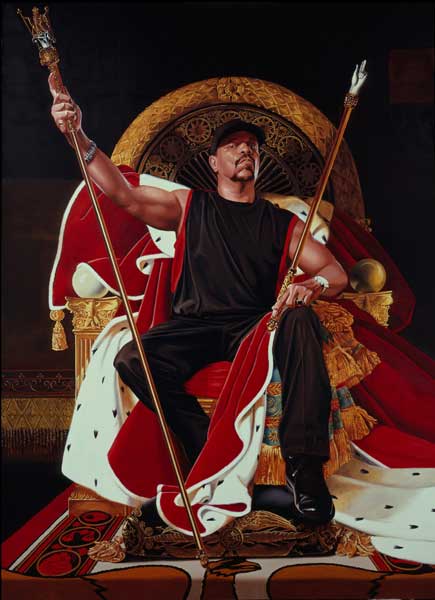
Kehinde Wiley, Ice T, 2005

Kehinde Wiley is a contemporary portraitist using traditional techniques and imagery to create canonical images of present-day black men, some celebrities and others regular folks. Wiley has a keen grasp of the history of Western painting, and his pictures contain layers of commentary on race, power, masculinity and self-image. By turns, Wiley samples precedents from the Dutch Old Masters, Italian Renaissance, Rococo, Pre-Raphaelites and even Socialist Realists. Unsurprisingly, his work has drawn both praise and criticism for replacing white kings, saints and Christ himself with young urban black men. At the National Portrait Gallery, the paintings feature hip hop pioneers such as Ice T, LL Cool J, Big Daddy Kane and Grandmaster Flash and the Furious Five, each of whose portrait is derived from one of a historical figure with whom the contemporary subject identifies. Wiley's work is also on view at the Studio Museum of Harlem through October 26.

Jefferson Pinder, Mule, 2006

Jefferson Pinder creates performances out of long-held stereotypes regarding the African-American experience. These are exhibited as videos in which the artist performs loaded actions that exaggerate and question our assumptions about the place and value of black people in American society. In Mule, Pinder drags a heavy load through a desolate urban landscape. He plays the part of an enslaved man, shackled to the past and to poverty, but his suit and sunglasses connote a conflicting image of upward mobility. Pinder's films are often accompanied by energizing music of his own composition, which enhance their emotional resonance and rhythmically punctuate the action. Pinder's work is also included in the exhibition After 1968: Contemporary Artists and the Civil Rights Legacy at the High Museum in Atlanta, GA, a major exhibition featuring seven young black artists whose projects respond to the history of civil rights in America.

Shinique Smith, No Thief to Blame, 2007-08

Shinique Smith, whose sculpture at Yvon Lambert in New York I covered earlier this week, has created a site-specific installation at the National Portrait Gallery as a response to poet Nikki Giovanni's commissioned poem for the exhibition, It’s Not a Just Situation: Though We Just Can’t Keep Crying About It (For the Hip Hop Nation That Brings Us Such Exciting Art). Giovanni is a hugely influential poet and a major contributor to the civil rights movement, and her writing has had an enormous impact on women of color in the United States. Smith's installation weaves together her signature calligraphic line with collage elements including images of hip hop's dearly departed -- tragic figures such as Tupac Shakur, Biggie Smalls, Lisa "Left Eye" Lopez and Easy-E whose deaths too young represent the darker side of the lifestyle celebrated in the exhibition. Smith informs her references to black urban culture with a deep current of Eastern philosophy. In this work, she may suggest that the suffering of her community could be alleviated by a lessened emphasis on self-inflicted injury in the name of authentically representing an oppressive past.

The National Portrait Gallery's 2007 renovation presented an opportunity for the NPG and its sister institution, the Smithsonian American Art Museum, to rethink how they present their historic collections of art objects to reflect the cultural values of today. They wisely chose not to preserve a monolithic view of American history, but also have avoided the politically-correct strategy of eliminating the more onerous figures within their galleries. Instead, the NPG presents a multifaceted view of American history in which portraits of famous slaveowners hang beside those of ex-slaves, and Native American and Latino heroes are presented alongside generals. The point is to engender a dialogue about the past which our country desperately needs. For this alone, it's worth a visit, but if you can get there before Recognize ends, you will really be in luck.

Subscribe in a reader

Monday, July 21, 2008

Radialvedic at Johansson Projects

The excellent Oakland gallery Johansson Projects, which I have covered here before, has just opened a new show, Radialvedic, featuring Ohio-based Jill Gallenstein and Bay Area-based Kristina Lewis and Kana Tanaka. I have been working with gallerist Kimberly Johansson since June to help bring this year-old gallery, with an exceptionally talented stable of emerging artists and a large, complex space with many intriguing sight lines, to a new level of reputation and success.

Jill Gallenstein, seeding the clouds detail, 2008

Jill Gallenstein is a multidisciplinary visual artist based in Columbus, Ohio, who has for the past year been creating intensely detailed, intricate drawings in pen and ink on paper. These dense clusters of ornamentation mutate and propagate across the negative space of the page, evolving as they spread. Titles such as Chemlawn and Smoker's Cough reflect the toxic elegance of Jill's compositions, betraying the beauty of their surfaces. Jill was an artist in residence at Headlands Center for the Arts this past spring, where I had the pleasure of getting to know her and recommended her to Kimberly. I am hopeful that theirs will be a long and fruitful partnership.
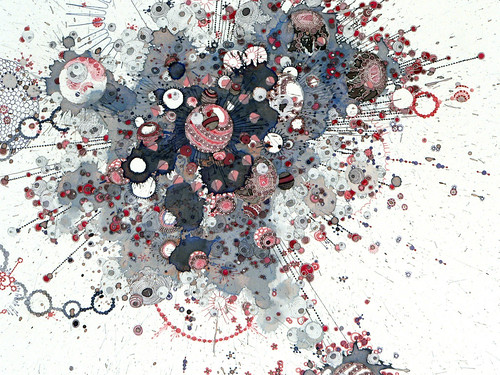
Kristina Lewis, Nurse, 2008

Kristina Lewis' sculptures appropriate mass-produced plastic products as the building blocks of new, abstracted life. She works according to systems and processes, attempting to avoid a predicated outcome. In this way she approximates the natural recombinations of amino acids, molecules and cells, which create life according to process rather than plan.


Kana Tanaka, Glass Drop, 2008

Kana Tanaka's installations of hot-formed glass interact with light to create atmospheric conditions within the gallery. These objects, integrated with the architectural features of a site, extend their phenomenological space to encompass viewers' bodies and movements.

Radialvedic is on view through August 30, with an Oakland Art Murmur party on August 1 from 5-9 pm (which will also mark my return to the Bay Area after this lengthy East Coast jaunt). If you're in the neighborhood, come in and say hello to the lovely ladies of JoPro.


Subscribe in a reader