Tuesday, July 22, 2008

Recognize: Hip Hop and Contemporary Portraiture at the National Portrait Gallery

The Smithsonian's National Portrait Gallery has taken a bold step into the 21st century with the exhibition Recognize: Hip Hop and Contemporary Portraiture, on view through October 26. Six visual artists and one poet were invited to present their interpretations of hip hop's legacy through the medium of portraiture, characterized as the representation of recognizable figures, in media including photography, video, painting, installation and graffiti.
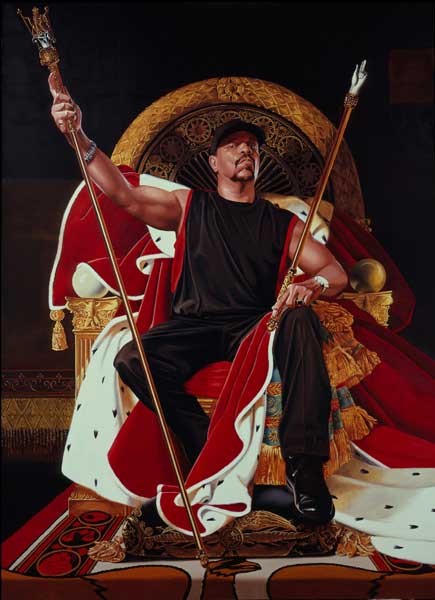
Kehinde Wiley, Ice T, 2005

Kehinde Wiley is a contemporary portraitist using traditional techniques and imagery to create canonical images of present-day black men, some celebrities and others regular folks. Wiley has a keen grasp of the history of Western painting, and his pictures contain layers of commentary on race, power, masculinity and self-image. By turns, Wiley samples precedents from the Dutch Old Masters, Italian Renaissance, Rococo, Pre-Raphaelites and even Socialist Realists. Unsurprisingly, his work has drawn both praise and criticism for replacing white kings, saints and Christ himself with young urban black men. At the National Portrait Gallery, the paintings feature hip hop pioneers such as Ice T, LL Cool J, Big Daddy Kane and Grandmaster Flash and the Furious Five, each of whose portrait is derived from one of a historical figure with whom the contemporary subject identifies. Wiley's work is also on view at the Studio Museum of Harlem through October 26.

Jefferson Pinder, Mule, 2006

Jefferson Pinder creates performances out of long-held stereotypes regarding the African-American experience. These are exhibited as videos in which the artist performs loaded actions that exaggerate and question our assumptions about the place and value of black people in American society. In Mule, Pinder drags a heavy load through a desolate urban landscape. He plays the part of an enslaved man, shackled to the past and to poverty, but his suit and sunglasses connote a conflicting image of upward mobility. Pinder's films are often accompanied by energizing music of his own composition, which enhance their emotional resonance and rhythmically punctuate the action. Pinder's work is also included in the exhibition After 1968: Contemporary Artists and the Civil Rights Legacy at the High Museum in Atlanta, GA, a major exhibition featuring seven young black artists whose projects respond to the history of civil rights in America.

Shinique Smith, No Thief to Blame, 2007-08

Shinique Smith, whose sculpture at Yvon Lambert in New York I covered earlier this week, has created a site-specific installation at the National Portrait Gallery as a response to poet Nikki Giovanni's commissioned poem for the exhibition, It’s Not a Just Situation: Though We Just Can’t Keep Crying About It (For the Hip Hop Nation That Brings Us Such Exciting Art). Giovanni is a hugely influential poet and a major contributor to the civil rights movement, and her writing has had an enormous impact on women of color in the United States. Smith's installation weaves together her signature calligraphic line with collage elements including images of hip hop's dearly departed -- tragic figures such as Tupac Shakur, Biggie Smalls, Lisa "Left Eye" Lopez and Easy-E whose deaths too young represent the darker side of the lifestyle celebrated in the exhibition. Smith informs her references to black urban culture with a deep current of Eastern philosophy. In this work, she may suggest that the suffering of her community could be alleviated by a lessened emphasis on self-inflicted injury in the name of authentically representing an oppressive past.

The National Portrait Gallery's 2007 renovation presented an opportunity for the NPG and its sister institution, the Smithsonian American Art Museum, to rethink how they present their historic collections of art objects to reflect the cultural values of today. They wisely chose not to preserve a monolithic view of American history, but also have avoided the politically-correct strategy of eliminating the more onerous figures within their galleries. Instead, the NPG presents a multifaceted view of American history in which portraits of famous slaveowners hang beside those of ex-slaves, and Native American and Latino heroes are presented alongside generals. The point is to engender a dialogue about the past which our country desperately needs. For this alone, it's worth a visit, but if you can get there before Recognize ends, you will really be in luck.

Subscribe in a reader

Monday, July 21, 2008

Radialvedic at Johansson Projects

The excellent Oakland gallery Johansson Projects, which I have covered here before, has just opened a new show, Radialvedic, featuring Ohio-based Jill Gallenstein and Bay Area-based Kristina Lewis and Kana Tanaka. I have been working with gallerist Kimberly Johansson since June to help bring this year-old gallery, with an exceptionally talented stable of emerging artists and a large, complex space with many intriguing sight lines, to a new level of reputation and success.

Jill Gallenstein, seeding the clouds detail, 2008

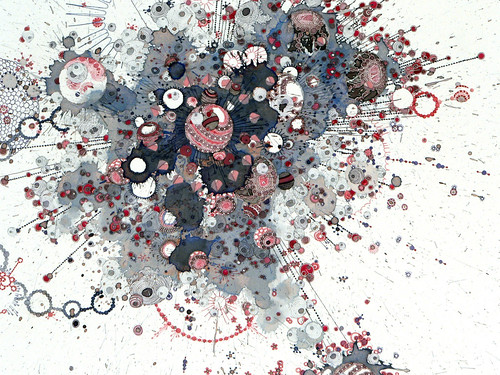
Jill Gallenstein is a multidisciplinary visual artist based in Columbus, Ohio, who has for the past year been creating intensely detailed, intricate drawings in pen and ink on paper. These dense clusters of ornamentation mutate and propagate across the negative space of the page, evolving as they spread. Titles such as Chemlawn and Smoker's Cough reflect the toxic elegance of Jill's compositions, betraying the beauty of their surfaces. Jill was an artist in residence at Headlands Center for the Arts this past spring, where I had the pleasure of getting to know her and recommended her to Kimberly. I am hopeful that theirs will be a long and fruitful partnership.

Kristina Lewis, Nurse, 2008

Kristina Lewis' sculptures appropriate mass-produced plastic products as the building blocks of new, abstracted life. She works according to systems and processes, attempting to avoid a predicated outcome. In this way she approximates the natural recombinations of amino acids, molecules and cells, which create life according to process rather than plan.


Kana Tanaka, Glass Drop, 2008

Kana Tanaka's installations of hot-formed glass interact with light to create atmospheric conditions within the gallery. These objects, integrated with the architectural features of a site, extend their phenomenological space to encompass viewers' bodies and movements.

Radialvedic is on view through August 30, with an Oakland Art Murmur party on August 1 from 5-9 pm (which will also mark my return to the Bay Area after this lengthy East Coast jaunt). If you're in the neighborhood, come in and say hello to the lovely ladies of JoPro.


Subscribe in a reader

Sunday, July 20, 2008

2007 Joan Mitchell Foundation MFA Grant Recipients at CUE Art Foundation

Each year, the Joan Mitchell Foundation awards grants to ten recent MFA graduates from US colleges or universities. The candidates are nominated by invitation, and their award year culminates in a summer exhibition at CUE Art Foundation in Chelsea. This year's show is on view through August 2.


Shay Church, Elephant, 2008

This year's highlights include Shay Church (San Jose State University), whose reclining elephant made from scavenged clay is cadaverous and yet strangely emotive. Though representational, Church's sculpture is mainly a form of land art, made from raw earth that the artist has labored to transport into the gallery in the tradition of Smithson's non-sites.


Stephanie Beck, Dencity, 2008

Stephanie Beck (Pennsylvania Academy of the Fine Arts) uses cut paper as an architectural material to build monochromatic landscapes that reflect the complexity of urban space. Some of her surfaces are built up to approximate buildings, while others are cut away to suggest the spidery lattices of our patterns of movement.


Vitus Shell, No More Afro Wigs, 2008

Vitus Shell (University of Mississippi at Oxford) conflates past and present in paintings that take pages from history as their ground. Shell collages images from newspaper advertisements that belie attitudes about race from the recent past, over which he paints portraits of contemporary African-Americans on whom the influence of those assumptions are seen.

Other artists in the exhibition include Laura Adams (Carnegie Mellon University), Natasha Bowdoin (Tyler School of Art, Temple University), Dara Louise Engler (Indiana University), Asuka Goto (Tyler School of Art, Temple University), Peter Gregorio (School of Visual Arts), Mayumi Komuro (Queens College, City University of New York), John McAllister (Art Center College of Design), Lydia Musco (Boston University), Andrew Patterson-Tutschka (Pennsylvania Academy of the Fine Arts), Sara Pedigo (University of Massachusetts at Amherst), Ryan Pierce (California College of the Arts), and Rosemary Taylor (Brooklyn College, City University of New York).

More images from the show can be seen here.

Subscribe in a reader

Saturday, July 19, 2008

The Stranger at Yvon Lambert

In what's become a Chelsea tradition, Yvon Lambert has a group show up this month that features old stalwarts (Anselm Kiefer, George Segal) and new recruits (Shinique Smith, Patricia Piccinini). The theme of the show is The Stranger, Albert Camus' 1946 novel of disconnection, apathy and murder. Perhaps this explains the show's coldness and lack of a cohesive thesis, or that may simply be a reflection of Chelsea and the current trends in the international art market.

Patricia Piccinini, The Long Awaited, 2008

Individual pieces within the show do resonate despite the gallery's staid atmosphere. The craftsmanship of Patricia Piccinini's sculpture The Long Awaited is outstanding, and the emotional resonance of her work is quite powerful. A child and a withered old creature, part monster and part grandmother, dream together in a loving embrace.

Shinique Smith, and, she has a bowl of lilacs in her room, 2008

Lambert has recently picked up Shinique Smith, a Brooklyn-based artist whose star is rising fast. In 2008 alone, she has been in shows at the New Museum, Socrates Sculpture Park, National Portrait Gallery, Yerba Buena Center for the Arts, The Rubell Collection, Deutsche Guggenheim, Contemporary Arts Center, New Orleans, and had a solo show at Saltworks in Atlanta, GA. Smith uses found and recycled clothing in sculptures which comment on nostalgia, international commerce, romance and female self-image. Her drawings incorporate calligraphic and graffitti writing, sumi ink painting and collage, and are often integrated into her sculptural installations.

George Segal, Seated Woman Reading, 1999

The novel of the title appears in George Segal's sculpture Seated Woman Reading, in which the woman in question sits at a table and ponders Camus' text. Her skin is International Klein Blue instead of Segal's signature Hydrocal white, possibly as an homage to the creative contributions of the French in the 20th century. Her surface is slightly worn, as though she has sat with her thoughts there a long time.

Anselm Kiefer, Asche fur Paul Celan, 2006

Kiefer's contribution is a beached rowboat made of lead, weighted down with leaden books. Surrounding it are concrete fragments shot through with twisted rebar. The effect is that of a quest for knowledge thwarted by the brutality of urban life, which the seeker has abandoned in search of some more hopeful goal.

Koo Jeong-A, Soo-I, 2004

Koo Jeong-A's quirky sculpture Soo-I perches high above the Kiefer, a cute and childlike figure utterly incongruous with the physical and psychological heaviness below. He seems to make a joke of despair and hopelessness, and so becomes the stand-in for a summer visitor. The moroseness of the show evaporates in the hot sun outside, the hustle of the city and the ephemerality of Chelsea.

For more images from this show, click here.

Subscribe in a reader

Friday, July 18, 2008

Victory Garden 2008: The Ark

One of the projects I'm most proud of from my time at Headlands Center for the Arts is the Victory Garden, a site-specific commissioned artwork that was the first new permanent installation on the Headlands' campus in 17 years. The project by Amy Franceschini and Michael Swaine is a 25' long "boat" moored at the Headlands' kitchen entrance, both a sculpture and a planter in which fresh herbs are grown for use in dinners made nightly for artists in residence and visitors. The artwork, at once a functioning garden and an aesthetic object, literally nourishes the artists and their community, and so is a metaphor for the mission of the Headlands.

The project was realized with the assistance of Headlands staff sharon maidenberg, Chris Doyle and Gary Sangster, and permiculturist Arcangelo Wessels. A public program and launch party on June 26 featured a reading by Cooley Windsor, whose short story Epios: a Sculptor is a melancholic tale of the artist who fashioned the Trojan Horse. Cooley's rumination on the sometimes torturous creative process was an inspiration for Amy and Michael's work. A talk by curator Clare Haggarty contextualized the project within 20th century Conceptualism, participatory art projects and social practices.

More images of the Victory Garden can be seen here.


Subscribe in a reader

Thursday, July 17, 2008

A few friends of note

Yesterday was my birthday, so I took the day off. Today I would like to introduce some terrific New York artists who also happen to be good friends of mine:

Abigail Feldman photographs the intimate and overlooked details of daily life. Her work deals with intimacy and alienation, the fear of knowing too much about others and of being known. Vulnerability and detachment characterize the work, which focuses on the clues people leave within their surroundings that provide insight into their inner lives. Abigail got her MFA from the School of Visual Arts and her BFA from Bard College.

Damaso Reyes bridges photojournalism and fine art in his work, which examines cultural specificity and universal connections around the globe. Damaso has photographed in Africa, Europe, Asia and all over the Western Hemisphere. His current project, The Europeans, chronicles the changing face of the new, multi-ethnic Europe in the wake of the European Union. Damaso got his BFA from Tisch School of the Arts at New York University.

Linda Draper is a singer-songwriter known for sweet and haunting melodies woven through with intense emotion. Linda's soft voice and unassuming demeanor draw listeners into a dreamlike state, while the fearless honesty of her lyrics can be a sharp wake-up call. She has written and recorded several self-published albums on her own, and recorded with The Voices, Major Matt Mason and other downtown/antifolk characters on the scene. She studied Music Composition at SUNY Purchase.

 Subscribe in a reader

Tuesday, July 15, 2008

Joseph DeLappe: The Salt Satyagraha Online—Gandhi’s Salt March in Second Life

Eyebeam is a non-profit in Chelsea dedicated to research at the intersection of art and technology. The exhibition on through July 19 features commissioned work by Joseph DeLappe and Taeyoon Choi.

Joseph DeLappe has recreated the Salt Satyagraha, a seminal moment in contemporary non-violent political protest organized by Mohandas K. "Mahatma" Gandhi in 1930, as a march through Second Life. The Salt Satyagraha was India's version of the Boston Tea Party, a civil disobedience action in which citizens reclaimed their right to produce salt directly from the sea, thus avoiding British commodity taxes which the Raj had imposed by law. The ban on salt-making, like most protectionist legislation, adversely affected the poorest people the most, as they were unable to afford refrigeration and were denied their traditional means of food preservation. Gandhi was arrested following the Salt March and remained in prison for about a year, during which time his status as India's preeminent civil rights leader was cemented. The Satyagraha campaign of non-violent protest against British colonial rule had a major international impact, and was one of Martin Luther King, Jr.'s main inspirations.


Joseph DeLappe, Reenactment: Gandhi at Dandi, 2008
"This image, of MGandhi at Dandi in SL was made several weeks after the end of DeLappe's performance/reenactment, just as the original photograph commemorating Gandhi's arrival at Dandi on April 6, 1930 was staged several days later, and at a different location altogether."-Eyebeam


DeLappe's Second Life Salt Satyagraha was conducted in real time using a specially modified treadmill. The artist walked the same distance as Gandhi on each day of the march, while his Second Life avatar traveled simultaneously through the virtual landscape. Along the way, he met landowners, warriors and political activists, whose comic-book style avatars typically dwarfed "MGandhi Chakrabarti." The avatar was created using a 3D digital scan of a plaster miniature model, which DeLappe upscaled into a 17-foot-high cardboard monument inside the gallery. Directions on how to make your own 17-foot cardboard Gandhi are available here.


The project serves two important functions - to remind us of the significance of the original Salt Satyagraha and Gandhi's non-violent mission, and to seek out and connect with political activists using Second Life as a forum for discourse and organizing. My own feelings about Second Life are generally that it fails to be anything more than a bloated web browser using weak animation technology to crudely approximate the world. However, I appreciate DeLappe's efforts to turn the media of our times (especially video games and the like) into usable political platforms.

More images from the show can be seen here.


Subscribe in a reader

Monday, July 14, 2008

Seher Shah

Seher Shah is a New York-based artist of Pakistani descent, who grew up mostly in London and Brussels. She trained as an architect, perfecting skills in perspective drawing and line work that are fully evident in her drawings and prints. In her work, Shah references Islamic iconography, appropriated images from the history of India and Pakistan, and American and European conceptual art, blending these influences into her own unique language.


Projective 2, 2007

Shah began her transition from architecture to art shortly after 9/11, when she found herself considering her Muslim faith and Pakistani identity afresh in the wake of the tragedy. She felt compelled to create a body of work which she titled Jihad Pop, in which the Qaaba, the holiest site in Islam, took on a second identity as a Minimalist black cube. As she continued to draw a series of progressions, this cube form expanded, collapsed and multiplied. As the work evolved formally, she began to broaden her visual cues beyond her own personal points of reference, incorporating the Christian cross and the Hindu lotus, for example.


Form Studies, 2007

More recently, Shah has begun to incorporate photographic records of the British colonization of India/Pakistan, which ultimately led to those two countries' separation during the shared national trauma referred to as Partition. This line of inquiry resonates strongly with me, as my own grandparents were displaced by Partition due to religious violence which affected Hindus and Muslims equally. The new project has led her to research the period both in England and in India, where she will spend much of this fall.

Seher Shah's work will be shown at Green Cardamom in London later this year.

 Subscribe in a reader

Sunday, July 13, 2008

The Wackness: a film by Jonathan Levine

"The Wackness," an independent film written and directed by Jonathan Levine, is an appealingly honest and simple film set in New York City in the summer of 1994, which tells the story of recent high school grad Luke Shapiro's (Josh Peck) transition from child to man. Luke is a dopey pot dealer with a drawling hip-hop affectation characteristic of the wealthy white city kids I knew at NYU around that time (it seemed like every Jewish kid on the Upper East Side fancied himself a Beastie Boy that year). He's a shy and thoughtful boy who hides behind a wall of nonchalance and drugs.

Luke's home life is falling apart, while his social life is nonexistent. His customers include a spacey hippie girl (Mary Kate Olsen, adequate in a tiny role that has garnered huge attention for the film), an agoraphobic former pop star (Jane Adams), and his psychiatrist, Dr. Jeffrey Squires (Sir Ben Kingsley). Squires trades Luke pot for therapy, although it's often hard to tell which is the doctor/adult and which the patient/child. Bereft of suitable role models, Luke reluctantly latches onto the drug-addicted, megalomaniacal and miserable Squires. At the same time, he begins to make inroads in his pursuit of Squires' stepdaughter, Stephanie (Olivia Thirlby), a popular, jaded classmate whose affection for Luke may or may not be genuine.

Squires, whose marriage to Stephanie's mother (Famke Janssen) is slowly dying, indulges in all manner of immature behavior with Luke, including a hook-up with Union (Olsen) in a phone booth that matters little to the story but has set the Internet abuzz. Stephanie, who has inherited her mother's studied detachment, seems to drop the facade around Luke - but keeps it in reserve with the knowledge that her wealthy clique will return at summer's end, and with it her class consciousness. Although Luke lives in the same neighborhood and attends the same school, his position as an outcast is inextricably tied to his economic need. Luke sells pot to pay for college, while his rich peers rip him off and his father (David Wohl) teeters on the brink of losing everything they have. He and Squires are the only people in their world who do any work, however half-assed and wasted, and this as much as their shared desperation is what bonds them.

The film's setting in 1994, with requisite period soundtrack by A Tribe Called Quest, Notorious B.I.G., KRS-One, Biz Markie and more, is intended to trigger nostalgia in viewers like myself who were Luke's age then. It does, but the film could as easily be set in the present day. It's really an indie genre film, blending elements of Harold and Maude, Say Anything, Igby Goes Down and The Royal Tenenbaums.

Josh Peck gives a solid performance, able to express enough intelligence and emotional nuance behind Luke's mask of carelessness to keep Kingsley from running away with the film. Kingsley seems to be having a terrific time with Squires, whom he makes both ridiculous and brilliantly compelling. Janssen, usually a strong actress, does a lot with a minor role, while Thirlby puts herself firmly in the running to be the next Scarlett Johansson. Method Man does his best Buju Banton as Percy, Luke's supplier.

"The Wackness" is about living through disappointment and loss, and as such it's a difficult film for a summer release. Most people would prefer to watch stories of heroism and redemption, peppered by explosions, at this time of year. Nonetheless, it's a worthwhile film and it ends on a high note of sorts. The film is distributed by Sony Pictures Classics, and is in limited run in only 31 theaters, but though it's unlikely to be another "Juno"-level hit*, I hope it does well enough that more films of this type can get national releases.

*Addendum: I retract my earlier prediction that this movie will not be a "Juno"-level hit after having seen two consecutive ads for it within one half-hour last night. It looks as though Sony Pictures Classics is following the "Juno" model after all - $100 million in advertising for a $10 million picture. So far "The Wackness" has grossed less than $500,000, but it remains to be seen whether Sony can buy a hit like Fox Searchlight did last year.

Subscribe in a reader

Friday, July 11, 2008

Neti Neti at Bose Pacia, New York

Bose Pacia, a gallery in Chelsea specializing in contemporary art from India, has an impressive summer show on now. Curator Peter Nagy started out in New York as an artist and the co-founder of Nature Morte, a seminal gallery in the East Village circa 1982-88. He moved to New Delhi in 1992, and five years later recreated Nature Morte in a city largely devoid of challenging contemporary art spaces. Nagy has organized a show featuring artists from within and outside India, which includes painting, photography, computer-generated art, textiles and sculpture.


Sheba Chhachhi, Ganga's Daughters (Initiation); untitled 3, 2001-7

While visiting the exhibition, I had the pleasure of meeting photographer Michael Buhler-Rose, who is in the process of completing his MFA from the University of Florida and relocating to New York. Michael's photographs in the exhibition focus on a community of Hare Krishnas based in Gainesville, FL, most of whom are of European-American descent but who have embraced the traditions and customs of India to a far greater extent than this Indian-American blogger, for one. The images knowingly reference exoticizing depictions of the East and the Other, found in paintings by Delacroix, Ingres, and later Gaugin.


Michael Buhler-Rose, Kalindi & Prtha, Alachua, FL, 2006

In particular, Buhler-Rose has focused on members of this community who are also students of Bharatanatyam dance, the Indian equivalent of ballet in grace and physical rigor. These models are performers, in control of their appearance at all times, thus retaining subjectivity in the face of the photographer's traditional, male gaze. The work combines classical imagery with strong photographic technique to complicate distinctions of time and cultural ownership. Adding further complexity is the fact that Buhler-Rose is a lifelong student of Indian religion, possessing a grasp of cultural nuance exceeding that of most Indians or Indian-Americans.


Michael Buhler-Rose, The Secret, 2006

Buhler-Rose will be exhibiting another body of work, related to the history of the Dutch East India Company and its relationship to Dutch still life painting of the same era, at the Museum of Fine Arts Boston in 2010. Neti Neti is on view at Bose Pacia through August 16.

 Subscribe in a reader

Wednesday, July 09, 2008

Studio Visit with Jon Rappleye

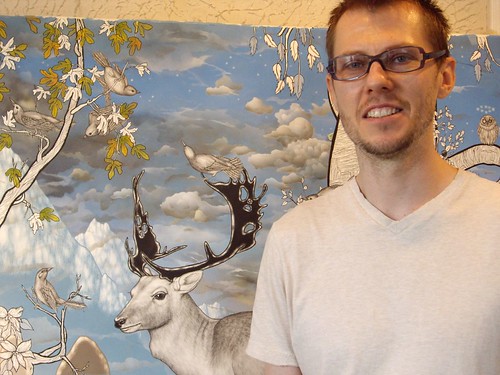
Today I visited one of my favorite artists and favorite people, Jersey City-based painter/sculptor Jon Rappleye. Jon just closed his first West Coast solo show at Richard Heller Gallery in Los Angeles, and also shows with Jeff Bailey Gallery in New York.


Jon in his Jersey City studio

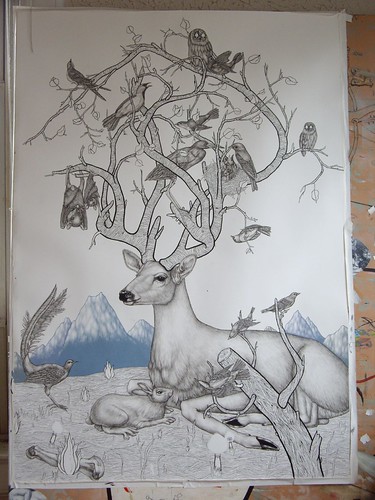
Jon specializes in hypnotic, beautiful and demented landscapes in which the animals have reconfigured with one another and taken over. Deer become trees, owls' eyes glow from within, snakes and frogs merge with rats and gophers. He works on large pieces of paper, drawing first in black and white and then masking off areas to create dramatic skies with spray paint behind his figures. The whole process is meticulous and detailed to a degree worthy of much respect. Also, just when I thought I couldn't adore Jon any more, he went and added octopi and bats to his repertory of animal characters, thereby proving me totally wrong.


New drawing in progress

Jon has also been working in sculpture since his stint in early 2007 as an artist in residence at the John Michael Kohler Arts Center in Sheboygan, Wisconsin. Yes, it's the same Kohler who make sinks and toilets, and yes, I said Sheboygan. His projects there included haunting owls and disembodied antlers, some covered with felt flocking. He'll also have an exhibition at Kohler later this year.


New drawing in progress

Jon's work is challenging both to those who don't understand why art would focus on the darker side of life, and to those who feel that contemporary art should never be pretty. Jon's work is unembarrassed in its beauty, but it's never easy to look at. He uses opulence as a tool to seduce the viewer into engaging with ideas of natural devastation and the obsolescence of humans, without fully realizing what he or she is getting into. It's gorgeous but not decorative, smart yet not preachy. Keep an eye on Jon Rappleye and I promise you he will do amazing things.

More images of Jon's studio are here.

 Subscribe in a reader

Tuesday, July 08, 2008

Sarah Wagner: Nuclear Family at Patricia Sweetow Gallery

The always lovely Sarah Wagner just closed her solo show at Patricia Sweetow Gallery in San Francisco. Sarah's signature silk organza creatures appear in this round as ghostly deer, quietly grazing on the gallery's concrete floor. The faces of the deer are especially well done, and Wagner's craftsmanship is exceptional, silk organza being a notoriously slippery translucent material.


Sarah and her partner Jon Brumit recently left the Bay Area for Chicago, where she is teaching at the Art Institute. It's great that Patricia Sweetow could bring her work back to SF, though no surprise since Patricia is a keen spotter of emerging talent here in the Bay Area and elsewhere.

Photos of the show are posted here.

 Subscribe in a reader

Monday, July 07, 2008

David Stein: Improbable/Unlikely at Eleanor Harwood Gallery

I just reviewed David Stein's show, Improbable/Unlikely, at Eleanor Harwood Gallery for Shotgun Review. You can read the full text of my review here.


Semesterville, 2008

David and I graduated together from California College of the Arts in 2005, along with Eleanor Harwood (who in addition to running an outstanding emerging art gallery is a terrific painter with a show up at Lincart right now), and Scott Oliver and Joseph del Pesco, Shotgun Review's founders. I am delighted to be in such an accomplished company of graduates, working hard to make the Bay Area a viable place for contemporary art.

Click here for a full photo set of David's show. It will stay up another week or so, past its planned closing date of June 28.

 Subscribe in a reader

Koh Myung Keun: Windows on Nature at Frey Norris

Koh Myung Keun is a photographer/sculptor from Seoul, Korea. His second solo exhibition at Frey Norris Gallery in San Francisco is Windows on Nature. Koh's signature photo-sculptures are made from ink jet prints on transparency, which he laminates between rigid pieces of clear plastic and stitches or welds together with a heat gun, forming three-dimensional hollow boxes in which the different semi-transparent image planes play off of one another. In this show, he looks at natural forms such as trees and foliage, ocean waves, the sky and open fields. The effect is soothing and meditative, perfect for a hot summer afternoon.


Koh Myung Keun, Water 4, 2008

I contributed an essay to the catalogue for the exhibition, published by the gallery. Koh was kind enough to post it on his website, where you can read it.

Windows on Nature runs through August 3. Frey Norris is at 456 Geary Street in San Francisco.

 Subscribe in a reader

Monday, May 05, 2008

East of the West at SomArts

I've been an absentee blogger lately, but it's for good reason. The show I co-curated with Taraneh Hemami, East of the West, opened last Thursday May 1 at SomArts Cultural Center in San Francisco.

East of the West features 16 artists from around the Bay Area, all of whom come from the region we generically call "the Middle East," but few of whom make art that we would typically relate to our conventions surrounding that part of the world. The artists, who range in age, approaches and length of time spent in the US, have origins in Iran, Egypt, Lebanon, Israel and Iraq.

The exhibition is sponsored by the Asian Pacific Islander Cultural Center, whose 11th Annual United States of Asian America Festival opened concurrently with our show. The festival features exhibitions, performances, screenings and readings taking place all over San Francisco, throughout May.

Artists in East of the West include Taha Belal, Youmna Chlala, Ali Dadgar, Dina Danish, Osama Dawod, Ala Ebtekar, Amir Esfahani, Mitra Fabian, Taraneh Hemami, Hiba Kalache, Bessma Khalaf, Nazanin Shenasa, Hadi Tabatabai, Nomi Talisman, Taravat Talepasand and Shadi Yousefian.

We'll have a panel discussion at the gallery on Wednesday, May 14, from 7-9 PM, co-sponsored by APICC and the San Francisco Arts Commission Gallery, in conjunction with our show and After the Revolution at San Francisco City Hall. The panel, moderated by Berin Golonu, Associate Curator at Yerba Buena Center for the Arts, will feature artists Youmna Chlala (East of the West) and Naciem Nikkah (After the Revolution), critic Soraya Murray and historian Maziar Behrooz.

We'll also have a satellite exhibition opening at Supervisor Ross Mirkarimi's office in City Hall on Friday, May 16. Scroll down for details.

Our curatorial statement follows, and pictures of the installation can be found by clicking the image below.


Amir Esfahani, Step Back (detail), 2008
Photo by Stephan Vladimir Bugaj

How can we begin to understand a region as diverse and far-ranging as the Middle East? We are constantly exposed to simplified images depicting this part of the world as rife with conflict, intolerance, religious fundamentalism and cruelty toward women and minorities. While certainly these strains exist, for the most part life goes on, as it does everywhere. Art is made, jokes are told, people are born, grow up, fall in love and get old.

When we were invited to do this show, we were initially hesitant. What purpose is there in creating another Middle East show, in inviting artists to show together based on their geographic origin rather than the ideas with which they engage or the methods they use to do so? Artists we approached expressed similar concerns: a resistance to being categorized and consequently marginalized, a reluctance to be seen as a “Middle Eastern artist.” However, we all agreed on the need to promote more diverse images of this part of the world, and so the show came to life.

The work takes three distinct threads. First is a dialogue with modern and contemporary art history as defined by Europe and the United States. The artists herein have studied and absorbed these precedents, and their responses are further informed by a parallel politics of the image, specific to the Muslim world, in which abstraction is a spiritual practice and word is image. Representation, personal appearance and control of the gaze reverberate differently within these two cultural perspectives.

Second is a questioning of cultures. As immigrants, we live between the old world and the new. Shaped by tradition, we embrace the freedom to choose our future paths while being acutely aware of expectations and strictures on all sides. We are insiders and outsiders in both worlds, attuned to the advantages and shortcomings of both ways of thinking, and knowing we will never be fully accepted by either.
¬¬
Third is a critique, often laced with humor, of the media’s one-dimensional portrayal of the Middle East. These tropes—fundamentalism, restriction of women, war and conflict, oppressive regimes, terrorism—are turned on end. Affronted by superficial assumptions, yet deeply aware of the real troubles that underlie them, we are caught between laughing and crying. We choose laughter and action over tears and disaffection.

Finally, we ask, East of what? West of whom? From where we stand—in California, the westernmost point in the Western world—the East is the West. Western Europe and the Middle East are much closer to each other than either is to us. From this point on our global sphere, we can see a new perspective. We adopt a new identity that is both East and West.


East of the West
SomArts Cultural Center Bay Gallery
934 Brannan Street, San Francisco
May 1 - 24, 2008
Hours: Tues-Fri 2-7PM, Sat 1-5PM

Extension: East of the West
Supervisor Ross Mirkarimi's Office, San Francisco City Hall
1 Dr. Carlton B. Goodlett Place, Room 244
Opening Reception: Fri, May 16, 5:00-8:00 pm
May 16 - June 17, 2008

 Subscribe in a reader

Friday, March 14, 2008

Gogol Bordello at the Warfield

Gogol Bordello played the Warfield in San Francisco last night. Their performance was outstanding - energetic, musically proficient, freakish and wonderful.

Having moved to California around the time of their first album's release, I just barely missed out on the first wave of this New York band's gypsy punk revolution. I became aware of them after seeing the film Everything is Illuminated, an excellent film based on a mediocre book, in which lead singer Eugene Hutz stole the whole show from Elijah Wood and so became a star. Recently Madonna has taken a shine to Hutz, and while I can't blame her, I hope readers will ignore that association and check out this terrific band anyway.


Eugene Hutz: 12 stories high, made of radiation

Why is this band so great? Well, I have a thing for Slavs, a fondness for both punk rock and shtetl music and a diasporic affinity for the Roma, whose roots can be traced back through history to my native India. So culturally, they're right up my alley. Their lively songs force you to dance with exuberance while singing along to lyrics like "all your sanity and wits/they will all vanish, I promise/It's just a matter of time." This defiant joy is, to my mind, what great music and art is all about. We have limited time here on Earth, but even as we age and decay every day, we will enjoy every minute, dammit!

Finally, who can resist a six-and-a-half foot tall moustachioed Ukrainian gypsy in hot pink stilettos? I mean, really.

Next week, Gogol Bordello plays the Southwest, followed by a super-fast European tour and an appearance at Coachella in April. In early May, Eugene Hutz promises to be back in Northern California for The 12th Annual California Herdeljezi Roma Festival, though it's not clear whether he'll be performing.

This also seems like a good opportunity to mention Paradise Lost: The First Roma Pavilion, an exhibition at the 2007 Venice Biennale featuring Roma-identified artists from across Europe. While the show was rough in many places, its spirit was robust, and it was an important step toward recognition and preservation of this unique and long-suppressed cultural heritage. Fear of a Roma planet? Not unheard of.


Damian Le Bas, Roma Europe, 2007

Other related bands: Balkan Beat Box, Leningrad, Yat Kha

 Subscribe in a reader

Monday, March 10, 2008

Whitney Biennial

I'm back from my Biennial tour, and the dust has begun to settle. I attended the press preview last Tuesday night as the guest of Bay Area-born Neighborhood Public Radio. The group has been in force since late 2004, but recent events in the core members' lives have fixed it so that they exist on more of an event basis now, coming together from their far-flung homes in Chicago, San Diego and Oakland for residencies and exhibitions such as this one. For the Whitney, they have taken over a storefront at 941 Madison Avenue, just up the block from the museum, and will be running a nonstop barrage of DIY variety radio out of that spot for three full months.

Neighborhood Public Radio's Whitney Biennial Stream

The NPR storefront is only one Biennial outpost this year. Several artists' work has been installed in the Park Avenue Armory. A series of performances that will run until March 23 had not yet begun when I visited, but the grand and decaying architecture is spectacular and worth a visit in itself. A few of the installations are strong enough to make an impact on this overwhelming environment. They include The Scarface Museum by Mario Ybarra, Jr., commemorating the fictional gangster's appeal to young Chicanos in his home of Los Angeles who too often follow their hero to his downfall; and Ties of Protection and Safekeeping by Portland, Oregon-based performance artist M.K. Guth.


M.K. Guth, Ties of Protection and Safekeeping, 2007-2008. Braided fabric and artificial hair

Architecture stakes its claim on the Biennial in more than one place this year. LA artist/architect Fritz Haeg's Animal Estates surround the museum's exterior. These habitats for wild creatures - few of whom are likely to be found on Madison Avenue any longer - endeavor to bring animals back into the urban environment by offering them viable living spaces. At the same time, they read as a poke in the eye to the high-rent Upper East Side, offering luxury accommodations for bobcats, bald eagles and brown bats.


Fritz Haeg, Animal Estates 1.0: New York, New York, 2008

Inside the museum, the highlights include Javier Tellez' powerful film, Letter on the Blind For the Use of Those Who See, in which six blind men encounter an aged elephant and describe the wonder of getting up close to this powerful, gentle being, while ruminating on their experiences in a sighted world. Mika Rottenberg's environmental video installation Cheese tells the story of six sisters who claimed to milk a hair-growth tonic from their own exceptionally long hair. The story plays out wordlessly on several screens embedded within a tattered wooden structure, the decrepit form of which contrasts with the sunny, high-quality production values of the accompanying videos.


Javier Tellez, Letter on the Blind For the Use of Those Who See, 2007. 16mm film transferred to high-definition video, color, sound; approximately 35 min.

Walead Beshty presents images of the abandoned Iraqi Diplomatic Mission in East Berlin, a site where the remnants of two collapsed regimes intersect in their neglect. The large-scale prints are themselves expressionless, except for a gentle colored glow which is the chance result of X-ray exposure. Adler Guerrier invents a long-dead political movement, "BLCK," addressing real history through fictional documentary. The artifacts he creates call our attention to true events that took place in Miami 1968, which have been forgotten by many these forty years later.

This being a Whitney Biennial, there's also plenty to hate, but fortunately there's enough to love that the show yet again warrants a visit.

 Subscribe in a reader