Wednesday, July 09, 2008

Studio Visit with Jon Rappleye

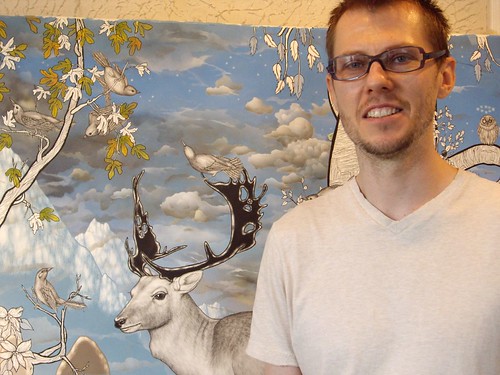
Today I visited one of my favorite artists and favorite people, Jersey City-based painter/sculptor Jon Rappleye. Jon just closed his first West Coast solo show at Richard Heller Gallery in Los Angeles, and also shows with Jeff Bailey Gallery in New York.


Jon in his Jersey City studio

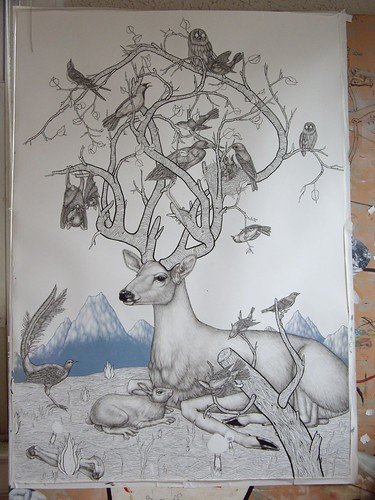
Jon specializes in hypnotic, beautiful and demented landscapes in which the animals have reconfigured with one another and taken over. Deer become trees, owls' eyes glow from within, snakes and frogs merge with rats and gophers. He works on large pieces of paper, drawing first in black and white and then masking off areas to create dramatic skies with spray paint behind his figures. The whole process is meticulous and detailed to a degree worthy of much respect. Also, just when I thought I couldn't adore Jon any more, he went and added octopi and bats to his repertory of animal characters, thereby proving me totally wrong.


New drawing in progress

Jon has also been working in sculpture since his stint in early 2007 as an artist in residence at the John Michael Kohler Arts Center in Sheboygan, Wisconsin. Yes, it's the same Kohler who make sinks and toilets, and yes, I said Sheboygan. His projects there included haunting owls and disembodied antlers, some covered with felt flocking. He'll also have an exhibition at Kohler later this year.


New drawing in progress

Jon's work is challenging both to those who don't understand why art would focus on the darker side of life, and to those who feel that contemporary art should never be pretty. Jon's work is unembarrassed in its beauty, but it's never easy to look at. He uses opulence as a tool to seduce the viewer into engaging with ideas of natural devastation and the obsolescence of humans, without fully realizing what he or she is getting into. It's gorgeous but not decorative, smart yet not preachy. Keep an eye on Jon Rappleye and I promise you he will do amazing things.

More images of Jon's studio are here.

 Subscribe in a reader

Tuesday, July 08, 2008

Sarah Wagner: Nuclear Family at Patricia Sweetow Gallery

The always lovely Sarah Wagner just closed her solo show at Patricia Sweetow Gallery in San Francisco. Sarah's signature silk organza creatures appear in this round as ghostly deer, quietly grazing on the gallery's concrete floor. The faces of the deer are especially well done, and Wagner's craftsmanship is exceptional, silk organza being a notoriously slippery translucent material.


Sarah and her partner Jon Brumit recently left the Bay Area for Chicago, where she is teaching at the Art Institute. It's great that Patricia Sweetow could bring her work back to SF, though no surprise since Patricia is a keen spotter of emerging talent here in the Bay Area and elsewhere.

Photos of the show are posted here.

 Subscribe in a reader

Monday, July 07, 2008

David Stein: Improbable/Unlikely at Eleanor Harwood Gallery

I just reviewed David Stein's show, Improbable/Unlikely, at Eleanor Harwood Gallery for Shotgun Review. You can read the full text of my review here.


Semesterville, 2008

David and I graduated together from California College of the Arts in 2005, along with Eleanor Harwood (who in addition to running an outstanding emerging art gallery is a terrific painter with a show up at Lincart right now), and Scott Oliver and Joseph del Pesco, Shotgun Review's founders. I am delighted to be in such an accomplished company of graduates, working hard to make the Bay Area a viable place for contemporary art.

Click here for a full photo set of David's show. It will stay up another week or so, past its planned closing date of June 28.

 Subscribe in a reader

Koh Myung Keun: Windows on Nature at Frey Norris

Koh Myung Keun is a photographer/sculptor from Seoul, Korea. His second solo exhibition at Frey Norris Gallery in San Francisco is Windows on Nature. Koh's signature photo-sculptures are made from ink jet prints on transparency, which he laminates between rigid pieces of clear plastic and stitches or welds together with a heat gun, forming three-dimensional hollow boxes in which the different semi-transparent image planes play off of one another. In this show, he looks at natural forms such as trees and foliage, ocean waves, the sky and open fields. The effect is soothing and meditative, perfect for a hot summer afternoon.


Koh Myung Keun, Water 4, 2008

I contributed an essay to the catalogue for the exhibition, published by the gallery. Koh was kind enough to post it on his website, where you can read it.

Windows on Nature runs through August 3. Frey Norris is at 456 Geary Street in San Francisco.

 Subscribe in a reader

Monday, May 05, 2008

East of the West at SomArts

I've been an absentee blogger lately, but it's for good reason. The show I co-curated with Taraneh Hemami, East of the West, opened last Thursday May 1 at SomArts Cultural Center in San Francisco.

East of the West features 16 artists from around the Bay Area, all of whom come from the region we generically call "the Middle East," but few of whom make art that we would typically relate to our conventions surrounding that part of the world. The artists, who range in age, approaches and length of time spent in the US, have origins in Iran, Egypt, Lebanon, Israel and Iraq.

The exhibition is sponsored by the Asian Pacific Islander Cultural Center, whose 11th Annual United States of Asian America Festival opened concurrently with our show. The festival features exhibitions, performances, screenings and readings taking place all over San Francisco, throughout May.

Artists in East of the West include Taha Belal, Youmna Chlala, Ali Dadgar, Dina Danish, Osama Dawod, Ala Ebtekar, Amir Esfahani, Mitra Fabian, Taraneh Hemami, Hiba Kalache, Bessma Khalaf, Nazanin Shenasa, Hadi Tabatabai, Nomi Talisman, Taravat Talepasand and Shadi Yousefian.

We'll have a panel discussion at the gallery on Wednesday, May 14, from 7-9 PM, co-sponsored by APICC and the San Francisco Arts Commission Gallery, in conjunction with our show and After the Revolution at San Francisco City Hall. The panel, moderated by Berin Golonu, Associate Curator at Yerba Buena Center for the Arts, will feature artists Youmna Chlala (East of the West) and Naciem Nikkah (After the Revolution), critic Soraya Murray and historian Maziar Behrooz.

We'll also have a satellite exhibition opening at Supervisor Ross Mirkarimi's office in City Hall on Friday, May 16. Scroll down for details.

Our curatorial statement follows, and pictures of the installation can be found by clicking the image below.


Amir Esfahani, Step Back (detail), 2008
Photo by Stephan Vladimir Bugaj

How can we begin to understand a region as diverse and far-ranging as the Middle East? We are constantly exposed to simplified images depicting this part of the world as rife with conflict, intolerance, religious fundamentalism and cruelty toward women and minorities. While certainly these strains exist, for the most part life goes on, as it does everywhere. Art is made, jokes are told, people are born, grow up, fall in love and get old.

When we were invited to do this show, we were initially hesitant. What purpose is there in creating another Middle East show, in inviting artists to show together based on their geographic origin rather than the ideas with which they engage or the methods they use to do so? Artists we approached expressed similar concerns: a resistance to being categorized and consequently marginalized, a reluctance to be seen as a “Middle Eastern artist.” However, we all agreed on the need to promote more diverse images of this part of the world, and so the show came to life.

The work takes three distinct threads. First is a dialogue with modern and contemporary art history as defined by Europe and the United States. The artists herein have studied and absorbed these precedents, and their responses are further informed by a parallel politics of the image, specific to the Muslim world, in which abstraction is a spiritual practice and word is image. Representation, personal appearance and control of the gaze reverberate differently within these two cultural perspectives.

Second is a questioning of cultures. As immigrants, we live between the old world and the new. Shaped by tradition, we embrace the freedom to choose our future paths while being acutely aware of expectations and strictures on all sides. We are insiders and outsiders in both worlds, attuned to the advantages and shortcomings of both ways of thinking, and knowing we will never be fully accepted by either.
¬¬
Third is a critique, often laced with humor, of the media’s one-dimensional portrayal of the Middle East. These tropes—fundamentalism, restriction of women, war and conflict, oppressive regimes, terrorism—are turned on end. Affronted by superficial assumptions, yet deeply aware of the real troubles that underlie them, we are caught between laughing and crying. We choose laughter and action over tears and disaffection.

Finally, we ask, East of what? West of whom? From where we stand—in California, the westernmost point in the Western world—the East is the West. Western Europe and the Middle East are much closer to each other than either is to us. From this point on our global sphere, we can see a new perspective. We adopt a new identity that is both East and West.


East of the West
SomArts Cultural Center Bay Gallery
934 Brannan Street, San Francisco
May 1 - 24, 2008
Hours: Tues-Fri 2-7PM, Sat 1-5PM

Extension: East of the West
Supervisor Ross Mirkarimi's Office, San Francisco City Hall
1 Dr. Carlton B. Goodlett Place, Room 244
Opening Reception: Fri, May 16, 5:00-8:00 pm
May 16 - June 17, 2008

 Subscribe in a reader

Friday, March 14, 2008

Gogol Bordello at the Warfield

Gogol Bordello played the Warfield in San Francisco last night. Their performance was outstanding - energetic, musically proficient, freakish and wonderful.

Having moved to California around the time of their first album's release, I just barely missed out on the first wave of this New York band's gypsy punk revolution. I became aware of them after seeing the film Everything is Illuminated, an excellent film based on a mediocre book, in which lead singer Eugene Hutz stole the whole show from Elijah Wood and so became a star. Recently Madonna has taken a shine to Hutz, and while I can't blame her, I hope readers will ignore that association and check out this terrific band anyway.


Eugene Hutz: 12 stories high, made of radiation

Why is this band so great? Well, I have a thing for Slavs, a fondness for both punk rock and shtetl music and a diasporic affinity for the Roma, whose roots can be traced back through history to my native India. So culturally, they're right up my alley. Their lively songs force you to dance with exuberance while singing along to lyrics like "all your sanity and wits/they will all vanish, I promise/It's just a matter of time." This defiant joy is, to my mind, what great music and art is all about. We have limited time here on Earth, but even as we age and decay every day, we will enjoy every minute, dammit!

Finally, who can resist a six-and-a-half foot tall moustachioed Ukrainian gypsy in hot pink stilettos? I mean, really.

Next week, Gogol Bordello plays the Southwest, followed by a super-fast European tour and an appearance at Coachella in April. In early May, Eugene Hutz promises to be back in Northern California for The 12th Annual California Herdeljezi Roma Festival, though it's not clear whether he'll be performing.

This also seems like a good opportunity to mention Paradise Lost: The First Roma Pavilion, an exhibition at the 2007 Venice Biennale featuring Roma-identified artists from across Europe. While the show was rough in many places, its spirit was robust, and it was an important step toward recognition and preservation of this unique and long-suppressed cultural heritage. Fear of a Roma planet? Not unheard of.


Damian Le Bas, Roma Europe, 2007

Other related bands: Balkan Beat Box, Leningrad, Yat Kha

 Subscribe in a reader

Monday, March 10, 2008

Whitney Biennial

I'm back from my Biennial tour, and the dust has begun to settle. I attended the press preview last Tuesday night as the guest of Bay Area-born Neighborhood Public Radio. The group has been in force since late 2004, but recent events in the core members' lives have fixed it so that they exist on more of an event basis now, coming together from their far-flung homes in Chicago, San Diego and Oakland for residencies and exhibitions such as this one. For the Whitney, they have taken over a storefront at 941 Madison Avenue, just up the block from the museum, and will be running a nonstop barrage of DIY variety radio out of that spot for three full months.

Neighborhood Public Radio's Whitney Biennial Stream

The NPR storefront is only one Biennial outpost this year. Several artists' work has been installed in the Park Avenue Armory. A series of performances that will run until March 23 had not yet begun when I visited, but the grand and decaying architecture is spectacular and worth a visit in itself. A few of the installations are strong enough to make an impact on this overwhelming environment. They include The Scarface Museum by Mario Ybarra, Jr., commemorating the fictional gangster's appeal to young Chicanos in his home of Los Angeles who too often follow their hero to his downfall; and Ties of Protection and Safekeeping by Portland, Oregon-based performance artist M.K. Guth.


M.K. Guth, Ties of Protection and Safekeeping, 2007-2008. Braided fabric and artificial hair

Architecture stakes its claim on the Biennial in more than one place this year. LA artist/architect Fritz Haeg's Animal Estates surround the museum's exterior. These habitats for wild creatures - few of whom are likely to be found on Madison Avenue any longer - endeavor to bring animals back into the urban environment by offering them viable living spaces. At the same time, they read as a poke in the eye to the high-rent Upper East Side, offering luxury accommodations for bobcats, bald eagles and brown bats.


Fritz Haeg, Animal Estates 1.0: New York, New York, 2008

Inside the museum, the highlights include Javier Tellez' powerful film, Letter on the Blind For the Use of Those Who See, in which six blind men encounter an aged elephant and describe the wonder of getting up close to this powerful, gentle being, while ruminating on their experiences in a sighted world. Mika Rottenberg's environmental video installation Cheese tells the story of six sisters who claimed to milk a hair-growth tonic from their own exceptionally long hair. The story plays out wordlessly on several screens embedded within a tattered wooden structure, the decrepit form of which contrasts with the sunny, high-quality production values of the accompanying videos.


Javier Tellez, Letter on the Blind For the Use of Those Who See, 2007. 16mm film transferred to high-definition video, color, sound; approximately 35 min.

Walead Beshty presents images of the abandoned Iraqi Diplomatic Mission in East Berlin, a site where the remnants of two collapsed regimes intersect in their neglect. The large-scale prints are themselves expressionless, except for a gentle colored glow which is the chance result of X-ray exposure. Adler Guerrier invents a long-dead political movement, "BLCK," addressing real history through fictional documentary. The artifacts he creates call our attention to true events that took place in Miami 1968, which have been forgotten by many these forty years later.

This being a Whitney Biennial, there's also plenty to hate, but fortunately there's enough to love that the show yet again warrants a visit.

 Subscribe in a reader

Wednesday, February 06, 2008

We Interrupt Your Program at Mills College Art Museum

Guest curator Marcia Tanner brings her expertise in the areas of feminist and technology-savvy art to the Mills College Art Museum in an excellent group show featuring 14 artists. Mills is a women's undergraduate college with a mixed-gender graduate program, and part of its museum's mission is to support women artists and curators with its programs. Tanner is a top-notch curator of new media art, and the two common pitfalls of that genre - techie work with weak artistic content, and gimmicky work that pulls its punches - are absent here.

The politics of the exhibition are pronounced without being shrill or strident. These artists apply a feminist sensibility to a 21st century context, assuming that women have professional and personal autonomy and choice, while asserting that feminist consciousness remains a necessity even in the face of some progress. For example, Gail Wight's installation, The Meaning of Miniscule, turns a feminist lens on the sciences, where women are admitted provided that they subdue their femininity and adhere to a rationalist agenda proscribed by that field's mostly male gatekeepers. Lest I paint too severe a picture, this installation is also great fun, consisting of an oversized microscope with a video "slide" that the viewer can control using the knobs on the scope's stem. One knob sorts through historical renderings of microbial organisms, while the opposite one generates sound bytes of knowledgeable-sounding science show hosts spouting empty yet authoritative pronouncements. A sequence of photo prints of shattered test tubes add an element of chance, further supporting Wight's riff on the pomposity of scientific certainty.


Gail Wight, The Meaning of Miniscule, 2006

Maria Antelman's contribution is a cryptic film comprised of still images with an apparently incoherent soundtrack. Further investigation reveals that the images were shot inside the disused NASA hangar at Moffett Field in Mountain View, north of San Jose, and that the voiceover is reading Hamlet's "to be or not to be" soliloquy translated into Klingon. The juxtaposition of two incomprehensible parts, each of which implies militancy despite its opaqueness, is both strange and comical. Adding to the charm is the fact that Antelman is a skilled photographer of arresting visuals.


Maria Antelman, tah pagh taHbe, 2006

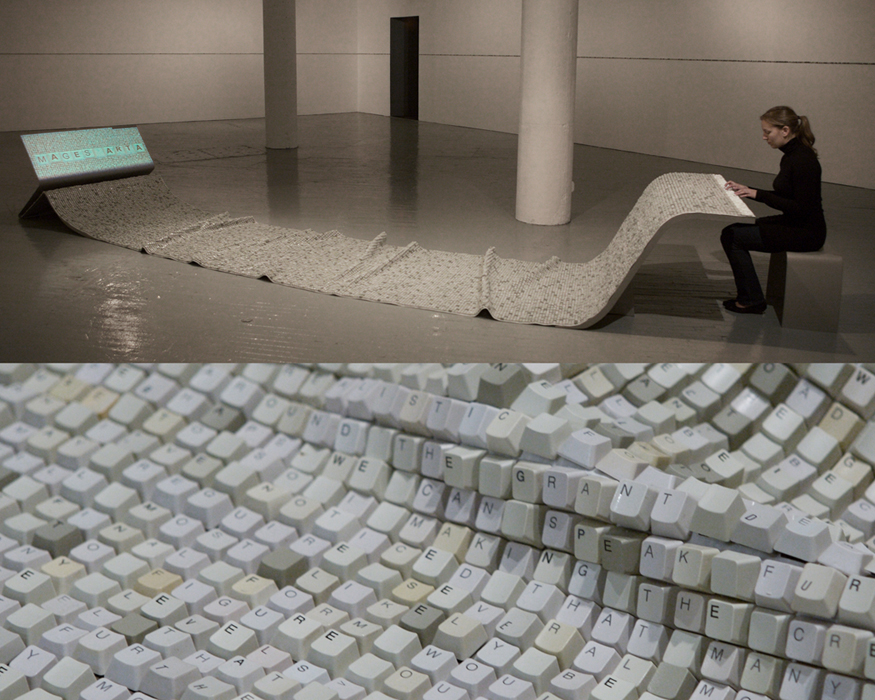
Jean Shin's sculpture, TEXTile, is a rumpled carpet made of computer keys. A screen at one end is connected to an activated keyboard at the other. The keys spell out the full text of Shin's email correspondence with the Fabric Workshop and Museum in Philadelphia, who originally commissioned the work. The activated keyboard is also comprised of this text, so that a visitor wishing to type messages onto the screen must hunt for keys amid the words. Shin has long worked in a participatory manner, using social networks to gather the materials and subjects of her installations. Her use of technology in this piece furthers that interaction with her audience, while complicating our relationships to familiar and ubiquitous tools.


Jean Shin, TEXTile, 2006

Julia Page's video Heir Apparent frames and highlights the obsessive media scrutiny paid to First Daughters Luci Baines Johnson, Tricia Nixon, Amy Carter and Chelsea Clinton. Their awkwardness is heartbreaking, and their self-awareness jarring. Adolescent girls, they are trapped in that most embarrassing time of life, yet on display to the world as tokens of American power, affluence and "family values."


Julia Page, Heir Apparent, 2004

Stephanie Syjuco contributes her first-ever video work, Body Double, a three-channel silent film about the use of her native Philippines as a stand-in for Vietnam in American war movies. Syjuco made her first trip back only recently, and before this she grew up seeing images that treated her country of origin solely as a stand-in for the most contentious conflict region in recent American history (until now).


Stephanie Syjuco, Body Double, 2006

The video consists of three classic Vietnam War films - Apocalypse Now, Platoon and Hamburger Hill. Syjuco blacks out all areas of the image that don't show the Filipino landscape, whether because actors appear in the frame or because the action takes place elsewhere. As such, one or more screens is black for much of the time, interrupted by rectangular excerpts of foliage and water. Even stripped of its context, the river featured in Apocalypse Now is instantly recognizable. Hollywood's appropriation of the Filipino landscape causes its jungles and rivers to be some of the most iconic and familiar in our culture, though we as a nation understand little of the Philippines.

There is plenty of work in this show that deserves mention, more than I can talk about here. It's well worth the drive into the heart of darkness (well, Oakland) to see this show.


 Subscribe in a reader

Saturday, January 12, 2008

Jenifer Wofford, Chris Bell, Bruce Tomb and Elaine Buckholtz at Southern Exposure

The venerable Southern Exposure, currently in a lovely temporary location on 14th Street between Valencia and Mission, presents four concurrent solo shows this month. There are several great projects by artists I've had the pleasure to work with in this one.

As you approach the gallery, a wave psychedelic light washes over the sidewalk, trees and passersby. This is Elaine Buckholtz' Scenes for a Box Carnival, an Op-Art inspired intervention into public space projected from the gallery's storefront windows.

The theatrical approach continues inside, with Slow Pan Interior, an installation by Chris Bell. An image of the gallery skips across its own walls, inverting the space in which we stand. Sydney-born Bell recently completed his MFA from Stanford and a subsequent residency at Headlands. His works are kinetic experiments, electrified and illuminated.


Detail of a poster on Bruce Tomb's Art Wall

In the bathroom, Bruce Tomb has mounted a new version of his (de)Appropriation Project Archive all over the walls. The installation consists of messages he culled from tags and posters on the "art wall" of a former police station he owns on Valencia Street. Tomb is an architect, designer and artist, who co-designed Headlands' latrine and has a business, Infinite Fitting, designing bathroom fixtures. So, a natural location for his installation, I guess.


Jenifer K. Wofford, Unseen Forces

Finally, in the rear gallery, is another of my favorite artists/people in the Bay Area, Jenifer K. Wofford. Her Unseen Forces installation is a continuation of a theme she began with her 2005 exhibition Chicksilog at the Richmond Art Center, which I had the pleasure of working on. In this iteration, all the Chicksilogs appear to have been detained by the Transportation Security Administration, leaving their island paradise an uninhabited and fully secure location bedecked with metal detectors. Wofford just finished getting her MFA from UC Berkeley, and is also the organizer of the international traveling exhibition project Galleon Trade, featuring other great Bay Area artists like Mike Arcega, Julio Cesar Morales, Stephanie Syjuco, and introducing Mexican and Filipino artists to SF, at the Luggage store later this year.

Southern Exposure will move again before the year is out. Check out their current space while you can, chill in their backyard bamboo garden, and say hello to the awesome and friendly staff: Courtney, Maysoun and Aimee.


 Subscribe in a reader

Sunday, January 06, 2008

Takashi Murakami at MOCA

Spent the weekend in LA and decided I could no longer make fun of the Louis Vuitton boutique inside MOCA's Takashi Murakami retrospective until I went to see it with my own eyes. I have always had a love-hate relationship with Murakami's work. On the one hand, as a lifelong lover of manga I appreciate the robust Japanese-ness of Murakami's particular post-apocalyptic cartoon vision. On the other, the equally robust and Japanese consumerism apparent in his works touches a sensitive nerve in me. The MOCA exhibition showed Murakami once again to be a keen manipulator of emotions, striking a host of cultural tender spots in a savvy and exuberant way. I simply couldn't help but give in to the gleeful horror of it all.


Hiropon, 1997. Oil, acrylic, fiberglass and iron. Edition of 3.

Back in graduate school in 2003-04, I struggled with my response to Hiropon (above) in the SFMOMA exhibition Supernova: Art of the 1990s from the Logan Collection. This image in particular disturbed me because of the often violent representations of women's sexuality prevalent in hentai, Japanese erotic comics and animations, and the relationship between that reality and Japan's rigidly patriarchal society. As I researched the work and Murakami's statements about it, I began to understand the ideological gymnastics he puts into play. Hiropon is a play on the collector mentality, and as a multiple available in large and small scales, editions and commensurate price ranges, it levels the relationship between the big-ticket art collector who buys a large sculpture for a half million dollars at Christie's and the teenage otaku (loosely translated: dork) whose miniature version came in a shokugan candy box.


Takashi Murakami's SuperFlat Museum Convenience Store Limited Edition - Hiropon/ Blue, 2004. Molded plastic.

The archetypical otaku is a boy in his teens or early 20s whose greatest fear is other people, and particularly the opposite sex. This anxiety manifests itself in sexual fantasies that are at once grotesque and strangely cute. Murakami protege Mr. represents the otaku run amok.


For Murakami himself, this is but one thread in his Warholian repertoire of consumerist critique. As with Warhol, it can be difficult to determine whether certain images of Murakami's are in fact critical or simply embracing of consumerism, and the Vuitton boutique which MOCA has notoriously placed within the exhibition galleries is an example of that critical dullness. Most offensively, it is the one boring part of an otherwise constantly exciting show, with nothing much to see. The fact that the sales don't even benefit MOCA does my non-profit arts administrator heart a bad turn, so enough about that misguided attempt at shock value.


Tan Tan Bo Puking - a.k.a. Gero Tan, 2002. Acrylic on canvas and wood.

Murakami is at his best when he synthesizes Japanese spiritual traditions with his anime influences. In Tan Tan Bo Puking, a form derived from his DoB character (a riff on Mickey Mouse) regurgitates toxic waste in a scene that could easily have appeared in anime master Hayao Miyazaki's 2001 classic Spirited Away. The painting is enormous, about 12 feet high by 24 feet wide, and truly impressive to comprehend. Like Miyazaki's film, Tan Tan Bo Puking incorporates symbols of the spirit world and suggests that environnmental devastation is throwing the order of things off-balance.


Oval Buddha, 2007. Aluminum and platinum leaf.

Some of the best work in the show is the newest. From Oval Buddha, 2007, a gigantic aluminum and platinum figure that can only be described as a mutant temple sculpture, to Second Mission Project Ko2, 1999-2000, an alarming female figure who transforms gruesomely from hentai girl to fighter jet, Murakami in his full career stride is pushing both sides of the envelope. The former work is alluringly spiritual in its meditative, architectural quality. The latter work is aggressive and vicious. Both use humor as an attractor and grotesqueness as a repellent, pushing and pulling the viewer. This duality is the essence of Superflat, at the heart of Murakami's vision.


Second Mission Project Ko2, 1999-2000. Fiberglass, iron, acrylic, and oil paint.


 Subscribe in a reader

Friday, January 04, 2008

Frederick Loomis: The Third Covenant at Steven Wolf Fine Arts

Happy new year!

Last night I went to see Frederick Loomis' solo show at Steven Wolf Fine Arts in San Francisco. Fred is a visionary artist who spent the first 25 years of his career drawing in staff meetings as a Marketing executive for Verizon. He took early retirement a few years back and got an MFA from California College of the Arts, which is where I first encountered his intricate and obsessive work in 2004.


Miriam Mosher, First Generation, Class 5 Anthropomorphic Computing Platform, 2005, colored pencil on paper

Fred's been getting some much-deserved attention lately. The image above appeared on the cover of Leonardo last winter (Vol. 40 No. 1, February 2007, MIT Press). It depicts the first generation of human computers endowed with a soul, the "Mother Platform." Her skin is made of 24K gold and her nervous system is fiber-optic. Loomis attributes all his work to his alter ego "Edward Mathew Taylor," whose visions in the 20th century predict the coming race of human computers and lay the foundation for a new techno-futurist religion.


The Dios Neurocontroller, 2006, pencil on paper

Taylor has had visions of "Mind Maps," mandalas crossed with microchips that describe a circuit of sentience. His prophecy draws from three sources: the Mormon Church of Latter-Day Saints, research to develop Artificial Intelligence in machines, and the 12-step recovery program. Like the Mormons, Taylor is engaged in the creation of new religious texts that reflect the circumstances of his contemporary society. These circumstances are defined largely by technological advancement, and the belief held by many in the AI and science-fiction communities (science and literature sides of the same coin) in the impending Singularity when computer evolution outpaces that of humans. He foresees that human failings such as addiction and cruelty will be eliminated by a superior race of computers that preserve mankind's better qualities while avoiding our worse ones.


Porters of the Third Covenant, 1991, pencil on paper

The exhibition also includes a series of older drawings that form "The Third Covenant," describing the lineage between extant Bible-derived religions and Taylor's new faith. A publication has been produced which includes all these drawings and the tenets of the Third Covenant. Loomis reports that the Third Testament will be his next undertaking, in the tradition of the Quran, the Book of Mormon, and Dianetics.

Fred insists that his intention is not actually to start a religion, but I say, if L. Ron Hubbard can have followers, Fred's mythology is way more seductive. He is a man with a mission, and I guarantee you will see much more from Fred Loomis.

Frederick Loomis: The Third Covenant
Through Feb 1, 2008

Steven Wolf Fine Arts
49 Geary St., Suite 411
San Francisco, CA 94108
415-263-3677
info@stevenwolffinearts.com

 Subscribe in a reader

Wednesday, October 17, 2007

2007 Venice Biennale photos online

I have finally posted my images from the Biennale up on Flickr. They can be seen here.


Yin Xiuzhen, China Pavilion

The Biennale was overwhelming to say the least. Lots of really strong work in the different international pavilions, mostly by young artists with promising careers ahead of them. Standouts were David Altmejd at the Canada Pavilion, Hyungkoo Lee at the South Korea Pavilion, the exhibition at the First Roma Pavilion, Sophie Calle at the French Pavilion, the Hong Kong Pavilion, the Chinese Pavilion, the Russian Pavilion and the two installations that made up the Scandinavian Pavilion.


David Altmejd, Canada Pavilion

There was no shortage of fresh energy in the international pavilions, but the main exhibition in the Arsenale and the Italian Pavilion were painfully dull by comparison. Curated by Robert Storr, former MoMA curator turned dean of the Yale School of Art, the two massive shows had a mausoleum feel, commemorating innovations long out of date and mostly serving to promote the curator's agenda over the advancement of contemporary ideas related to the art and culture of today.


Yang Fudong, Arsenale

I also visited Documenta 12 and Skulptur Projekte Munster this summer, and will eventually post those images. Stay tuned.

 Subscribe in a reader

Monday, August 20, 2007

The Present Group

The Present Group is an art subscription service based in Oakland. For $150, roughly twice the cost of a leading contemporary art magazine, you can receive an original piece of art every quarter. The first two issues were multiples by Ethan Ham and Benjamin Rosenbaum (spring) and Presley Martin (summer), but in September they'll be releasing a new set of unique drawings by Christine Kesler. Christine drew these on the road from Brooklyn to SF, where she recently moved to start grad school at CCA. She should be well served by a department that helped shape the work of Leslie Shows and Val Britton, two artists with comparable interests in painting as topography.

That's all I can tell you for now, except that I'll be contributing a short essay on Christine's work to the September release. Watch for it.


 Subscribe in a reader

Monday, August 06, 2007

Sunshine - a film by Danny Boyle

Scottish director Danny Boyle's eighth film, Sunshine, is an ambitious and moody space thriller that starts out great and ends up somewhere between "pretty good" and "kinda good." The cinematography and art direction, especially lighting, sound and set design, are outstanding. The performances by supporting actors Cliff Curtis, brilliant (can't resist) as the spaceship psych officer addicted to bathing his inner darkness in light, Hiroyuki Sanada, as the stoic Captain Kaneda, and the ever-awesome Michelle Yeoh, as Corazon, tender of the Oxygen Garden, are pitch-perfect. Lead Cillian Murphy is pleasing to look at and not annoying, which is probably enough, though I don't really buy him as a nuclear physicist (perhaps I've met too many).


The first act is wonderfully languid in the best space-is-so-big tradition. The earth has become a frozen wasteland, and a team of astronauts cast by Benetton in a ship predictably called Icarus are on their way to the sun to detonate a nuclear payload that they hope will jump-start the dying star. The second act sets up a compelling psychological conflict, between playing things safe and taking risks to get better results, as the crew intercepts a signal from the sister spaceship whose mission was lost seven years earlier, and attempts to rationalize their curiosity about the lost ship with justifications based on flimsily calculated benefits. All perfectly good fodder for a psychological thriller about the vast loneliness of the universe and the hell that is other people.

Unfortunately, in the third act this film suddenly becomes a cheesy slasher flick. Too in love with their characters to make them compellingly conflicted, Boyle and writer Alex Garland transfer all that conflict onto a barely justified bogeyman out to thwart the dwindling crew of surviving goody-goodies. It's so much more interesting when the characters are their own enemies, torn between self-interest and the good of others, a conflict that Boyle navigated skillfully in Shallow Grave, Trainspotting and even the adorable kid flick Millions. But here he pulls his punches, allowing all the characters who have survived the first and second acts to choose goodness and service while introducing a hastily sketched surrogate for their darker impulses. The last half-hour of the film involves many blurry chase scenes, and several incidents where the ship is damaged and the crew must race against time and the psycho to keep the whole thing from blowing up.


Sunshine starts off drawing heavily on 2001: A Space Odyssey, references Alien but ultimately ends up in territory closer to the pre-Titanic James Cameron's underwater disaster snoozer The Abyss. In that movie, a group of stranded submariners were picked off one-by-one by a water phantom that represented their darkest impulses and fears. The Abyss was a far worse film than Sunshine, which has most of its problems at the end and looks great throughout, but it's a weak position to end up with when you aimed for the company of Kubrick and Ridley Scott. You should still see Sunshine if you like spaceships, fire or Irish girly boys. All of which are good things.


 Subscribe in a reader

Saturday, August 04, 2007

Ala Ebtekar at Gallery Paule Anglim

Ala Ebtekar makes beautiful drawings based on contemporary and ancient Iranian myths. At Anglim he is showing a series of paintings in acrylic, ink and watercolor that use book pages written in Farsi as their support. The largest paintings in the show bear the image of a winged centaur, a familiar Mediterranean motif. Somehow he doesn't seem particularly happy about the belligerency focused toward, and emanating from, his home territory.


Smaller works are bordered with collapsed piles of fallen heroes. Casualties of the ancient war described in the Farsi text (the canonical Shahnameh or Epic of Kings), they could as well have been felled by the coming one to be provoked by the dual mad rages of Ahmedinijad and George W.


It's a busy season for Ala, as he has also recreated his 2004 installation Elemental for the Asia Society's traveling show "One Way or Another: Contemporary Asian Art Now," opening at the Berkeley Art Museum on September 19. A show of drawings related to his 2006 shows Emergence at Richmond Art Center and Emergence: Elements at Anglim, closed earlier this year at The Third Line in Dubai, UAE. Having had the pleasure of curating his show at Richmond, I could not be happier that he's garnering some international attention.

There's more to report, about the adjacent show by Bull.Militec, but that will have to wait until I see the second part of that installation, in "Dark Matter" at Yerba Buena Center for the Arts. Watch for it next week.

 Subscribe in a reader